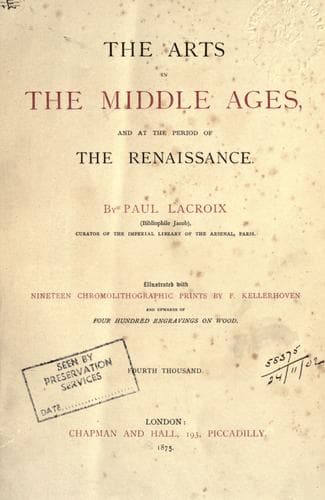
The Arts in the Middle Ages and at the Period of the RenaissanceJacob, P. L.
History
The Arts in the Middle Ages and at the Period of the Renaissance
Jacob, P. L.
Art, Medieval; Art, Renaissance; Middle Ages
“Allegory,” says M. Michiels, “was the first language of Christian
painting; not only did it express typically the Evangelical teachings,
but the Divine personages themselves were metamorphosed into symbols.
Sometimes, for instance, Christ appeared in the form of a young
shepherd, bearing on his shoulders and carrying back to the fold a
wandering sheep; sometimes He was represented as the Orpheus of the new
faith, charming and taming ferocious animals by the sound of His
lute.... He also was made to assume the form of the lamb without spot,
or of a phœnix spreading its wings, the conqueror of death and the
spirits of darkness. Thus was the transition softened down; thus did
they escape the raillery of Pagans who would have turned into ridicule
the heroic sufferings and the glorious humiliations of the Son of man.
But this timidity could not long continue.... The council held at
Constantinople in 692 commanded that allegory should be repudiated, and
that the objects of their veneration should be displayed to the faithful
without the veil hitherto employed. Now was exhibited to view a
spectacle new indeed to men; a Deity crowned with thorns, enduring the
outrages of a vile populace, or stretched upon a cross and pierced with
a lance, turning His sad glance to heaven and wrestling with His agony.
The Greeks and Latins were but slow in adopting this mode of
representation, and did so with regret.... But the perception of moral
dignity was destined to eclipse the vain pomp of Pagan grandeur. The
generous sufferings of sacrifice were to become the greatest of all
glories.”
“Christian painting, when once established as an art on the banks of the
Bosphorus, assumed a certain immobility of character. Forms, attitudes,
groups, and vestments--all were regulated by ecclesiastical
prescription. There was, as it were, an inflexible text-book, to which
artists were bound to submit. Delicacy of colouring and nobility of
attitude were the only things to recall the beauty of ancient art. Even
in our days the Greek and Russian painters follow a similar plan,
drawing and arranging their figures in the same manner as their
ancestors of the time of Honorius and the Palæologi.”
Public-domain text, read in full here on John Shaqi.
Reviews
Reviews
No reviews yet
Be the first to share your thoughts on this work.
Elsewhere in the archive
Join the Discussion
Join the discussion
Sign in to leave a comment or review.
Sign InorCreate an account