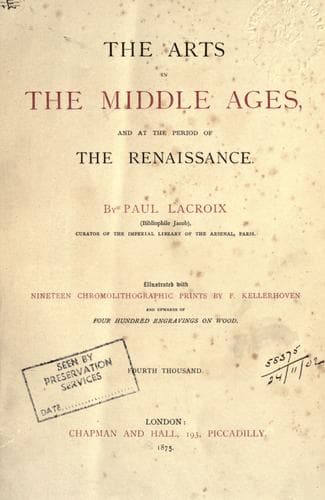
The Arts in the Middle Ages and at the Period of the RenaissanceJacob, P. L.
History
The Arts in the Middle Ages and at the Period of the Renaissance
Jacob, P. L.
Art, Medieval; Art, Renaissance; Middle Ages
The year 1240 witnessed the birth of Cimabue: as a young man, he became
enamoured of art by watching the labours of the Greek painters who had
been summoned to Florence to decorate the chapel of the Gondi. It was
purposed to make him a _savant_ and a lawyer; but he succeeded in
abandoning the pen in favour of the pencil, and, from the lessons of the
timid Byzantines, he soon became a master whose every thought was
henceforth devoted to the emancipation of an art that he found condemned
to a kind of immobility. Thanks to him, the expression of faces, which
up to that time had been entirely conventional in character, was
animated by a truer sentiment; the lines of drawing, which had been hard
and stiff, were broken up into well-ordered grace; the colouring,
hitherto dull and gloomy, assumed soft brilliancy and harmonious relief.
It is said that Cimabue’s _chef-d’œuvre_, the “Madonna” which is still
to be seen in the Church of Santa-Maria-Novella, was carried in
procession by the crowd to the place which it now occupies; the painter
was received with shouts, and, it is added, the joy of the people at the
sight of the picture was so great that the part of the city wherein
Cimabue’s studio was situated received, after this event, the name of
_Borgo Allegro_ (the Joyous Town). One day when Cimabue was in the
country, he noticed a young shepherd-boy who was amusing himself by
sketching on a rock the sheep he tended. The painter took charge of the
boy; he became his favourite pupil, and was the celebrated Giotto, who
happily persevered in the reform commenced by Cimabue. Giotto, the first
among the artists of his time, ventured to paint portraits, and
succeeded well in them. To him we owe our acquaintance with the real
features of his friend Dante; and we still admire, at least as
manifestations of an adventurous genius, the paintings he left in the
Church of Santa Clara at Naples, in the Cathedral of Assisi, and
especially in the Campo Santo at Pisa, where he painted in fresco the
history of Job.
Public-domain text, read in full here on John Shaqi.
Reviews
Reviews
No reviews yet
Be the first to share your thoughts on this work.
Elsewhere in the archive
Join the Discussion
Join the discussion
Sign in to leave a comment or review.
Sign InorCreate an account