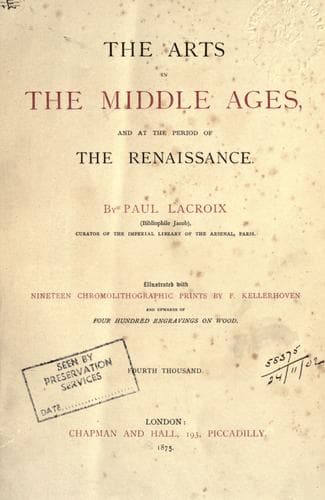
The Arts in the Middle Ages and at the Period of the RenaissanceJacob, P. L.
History
The Arts in the Middle Ages and at the Period of the Renaissance
Jacob, P. L.
Art, Medieval; Art, Renaissance; Middle Ages
The Florentine school (for thus we call the group of artists who trod in
the footsteps of Cimabue and Giotto) had for its representative, at the
beginning of the fifteenth century, Giovanni of Fiesole, surnamed _Fra
Angelico_, the personification of enthusiasm in artistic sublimity;
whose works, too, resemble so many hymns of adoration. Born in the year
1387, and inheriting great wealth, he was endowed with a contemplative
mind, and, ignorant of the talent which inspired him, he sought oblivion
from the world in the garb of a Dominican, little suspecting that glory
awaited him in the very depth of his humility. At first, as a kind of
pious recreation, he covered with miniatures several pages of
manuscripts; next, his companions in the cloister requested him to
paint a picture. He obeyed, feeling convinced that the inspiration which
stirred within him was a manifestation of the Divine spirit, and it was
with the most artless simplicity that he referred to this celestial
origin the _chef-d’œuvre_ which proceeded from his hands. His reputation
spread far and wide. At the invitation of the head of the Christian
Church, he repaired to Rome in order to paint one of the chapels of the
Vatican. And when the pontiff, full of enthusiasm at his talent, wished
to confer upon him as a reward the dignity of archbishop, Angelico
retired modestly to his cell in order to devote himself without
interruption to that art which was to him a continual prayer, and a
perpetual soaring up to that heavenly country on which he unceasingly
meditated with all the unutterable feelings of the elect.
About the same era as the “seraphic monk,” who died full of years in
1455, appeared Tomaso Guidi, for whom a kind of unconsciousness of
everyday life had obtained the ironical _sobriquet_ of Masaccio (the
Stupid); who, however, astonished the world by his works to such extent
that it was said concerning them, “those of his predecessors were
_painted_, but his were _living_.” Masaccio was one of the first (and
this fact shows how slowly art may progress even in bold hands) to place
in his pictures firmly on the soles of their feet figures presenting a
full front, instead of making them stand upon their great-toes, as his
predecessors had done from a want of knowledge of the requisite
foreshortening. Masaccio died in 1443.
Public-domain text, read in full here on John Shaqi.
Reviews
Reviews
No reviews yet
Be the first to share your thoughts on this work.
Elsewhere in the archive
Join the Discussion
Join the discussion
Sign in to leave a comment or review.
Sign InorCreate an account