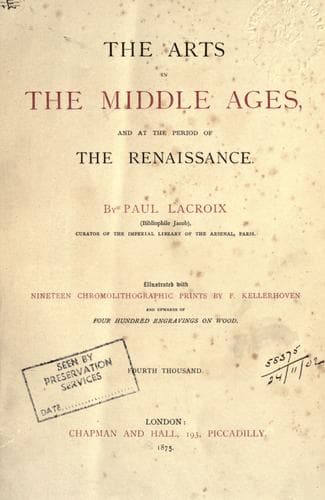
The Arts in the Middle Ages and at the Period of the RenaissanceJacob, P. L.
History
The Arts in the Middle Ages and at the Period of the Renaissance
Jacob, P. L.
Art, Medieval; Art, Renaissance; Middle Ages
At Venice a body of pioneers, still more numerous and compact, prepared
the way for the new era, destined to be made illustrious by Titian,
Tintoretto, and Paul Veronese. We will mention also Gentile and Jacopo
Bellini; the former was incessantly absorbed in investigating the
theories of an art which he nevertheless exercised with all the
_abandon_ of an inspired genius; the latter constantly devoted himself
to the combination of power and grace; and, at the age of seventy-five
years, seemed to regain a second youth in following with happy boldness
the example of his pupil Giorgione.[35] This painter, who was born in
1477, and died in 1511, introduced all kinds of innovations in respect
to design and colouring, and was the master of Giovanni da Udine,
Sebastian del Piombo, Jacques Palma, and Pordenone, fellow-pupils and
sometimes rivals of the three great artists by whose works the Venetian
school was to mark its individuality.
At Parma a local school was represented by Antonio Allegri, called
Correggio, born in 1494; and by Francesco Mazzuoli, called Parmigianino,
born in 1503.
In other places, too, talents of a vigorous or of a graceful character
were developed, but we can only cast a comprehensive glance on this
memorable artistic epoch, and are unable to offer a detailed review of
the artists and their works. And what further luminaries of art could we
wish to embrace in our summary after having displayed in it, shining, so
to speak, at one and the same epoch, Leonardo da Vinci (Fig. 249),
Michael Angelo, Raphael, Titian, Tintoretto, Veronese, Correggio, and
Parmigianino?
[Illustration: Fig. 249.--Portrait of Leonardo da Vinci, from a Venetian
Engraving of the Sixteenth Century.]
Four principal schools compete with one another--the Florentine school,
the characteristics of which are truth of design, energy of colouring,
and grandeur of conception; the Roman school, which seeks its ideal in
the skilful and sober judgment of its lines, the dignity of its
compositions, propriety of expression and beauty of form; the Venetian
school, which occasionally neglected correctness of drawing, and devoted
itself more to the brilliancy and magical effect of colour; lastly, the
school of Parma, which is distinguished especially by its softness of
touch and by its knowledge of light and shade. All such estimations of
the different qualities of these various groups must not, however, be
looked upon as in any way absolute.
Public-domain text, read in full here on John Shaqi.
Reviews
Reviews
No reviews yet
Be the first to share your thoughts on this work.
Elsewhere in the archive
Join the Discussion
Join the discussion
Sign in to leave a comment or review.
Sign InorCreate an account