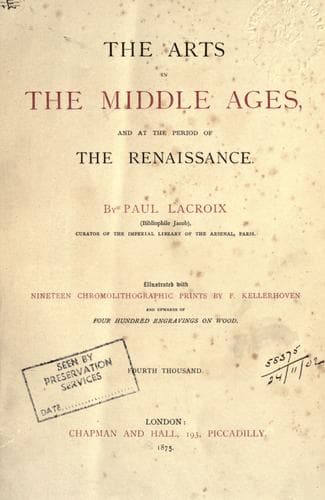
The Arts in the Middle Ages and at the Period of the RenaissanceJacob, P. L.
History
The Arts in the Middle Ages and at the Period of the Renaissance
Jacob, P. L.
Art, Medieval; Art, Renaissance; Middle Ages
Thanks to the studios of Agnolo and Agostino, Siena, a small town which
calls to mind the ancient Sicyone, so weak in a political point of view
and yet so learned and polished, was for some time the rival of Pisa, up
to the period when Florence absorbed the artistic splendour of the two
cities. Florence, as the home of the Arts, became the centre of
radiation, whence artists took their flight over the whole of Italy, and
from Italy spread among all the nations of Europe.
Towards the end of the thirteenth century, the churches of Florence, on
which the fraternities combined their efforts, and some of the civil
buildings of this rich and flourishing city, were filled with statues.
The foundation of the municipal palace in 1282, and that of the
cathedral in 1298, made these two wonderful edifices real museums of
sculpture, in which, among the works of Eastern artists, those of
Giovanni of Arezzo and Giotto are distinguished. Agostino and Agnolo of
Pisa executed at that time some magnificent examples at Santa Maria in
Orvieto, San Francisco in Bologna, and in the subterranean Church of
Assisi, &c. Lastly, Andrea of Pisa, a contemporary of Giotto, as he died
only in 1345, extracted from antiquity all that Christian sculpture
could borrow from it; that is, he combined sublimity both of form and
expression. At Pisa, the chancel of Santa Maria a Ponte; at Florence,
the campanile and the high-altar of Santa Maria de’ Fiori, and a door of
San Giovanni; in the Cathedral of Pistoia, the tomb of Cino, are all of
them so many masterpieces; above which, however, the old Pisan master
proudly classed the works of his son Nino. This young artist, who carved
the monument of the Scaligers at Verona, became, in fact, the worthy
follower of the school which recognised Andrea as its chief. Jacopo
della Quercia and Niccolo Aretino enriched also with magnificent works
the towns of Siena, Lucca, Bologna, Arezzo, and Milan, as well as
Florence. But when, in 1424, the tomb closed over Jacopo della Quercia,
the lofty destinies of the art seemed to come to a termination, and soon
rapidly declined. In Venice, at the death of Filippo Calendario, which
occurred in 1355, Italian sculpture had already lost much of its
nobility and vigour of style.
Public-domain text, read in full here on John Shaqi.
Reviews
Reviews
No reviews yet
Be the first to share your thoughts on this work.
Elsewhere in the archive
Join the Discussion
Join the discussion
Sign in to leave a comment or review.
Sign InorCreate an account