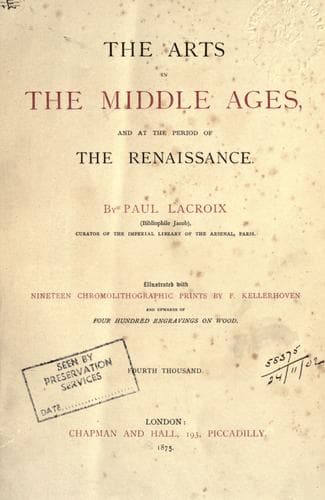
The Arts in the Middle Ages and at the Period of the RenaissanceJacob, P. L.
History
The Arts in the Middle Ages and at the Period of the Renaissance
Jacob, P. L.
Art, Medieval; Art, Renaissance; Middle Ages
Montereau, who at one time as military architects, at another as
sculptors of sacred subjects, were at the command of St. Louis, and
produced some extraordinary works both of construction and sculpture.
Alsace manifested no less enthusiasm than France for the new
architectural system, and sculpture was also subject to a similar
development. From Basle to Mayence, the slopes of the Vosges and the
long valley of the Rhine, became full of edifices enriched with
sculpture and peopled with statues. Erwin of Steinbach (who died in
1318), assisted by Sabina, his daughter, and William of Marbourg, were
the most renowned masters in these parts.
[Illustration: Fig. 285.--Bas-relief formerly over the Doorway of St.
Julien le Pauvre, Paris, representing St. Julien and St. Basilissa, his
wife, conveying in their boat Jesus Christ under the figure of a Leper.
(Thirteenth Century.)]
The extraordinary advance that French sculpture made in this age was
assisted--if not as regards the higher style of work, which could do
without this help, at least in respect to the minor details of the
art--by the institution of the fraternities of the _Conception
Notre-Dame_. In many towns the sculptors of images and the painters, the
moulders, the _bahutiers_, or carvers in wood, horn, and ivory (Fig.
286), were all united under the same banner. In Germany and Belgium also
existed _hanses_, or guilds, which were in direct communication with
those of Alsace, and who accepted as guides French artists of known
ability; as, for instance, Volbert and Gérard, architect-sculptors, who
were simultaneously engaged in the construction of the Church of the
Holy Apostles, Cologne.
[Illustration: Fig. 286.--Fragment of a small Reredos, in carved Bone
(Fourteenth Century).
Presented by Jean, Duc de Berry, Brother of Charles V., to the church of
the ancient Abbey of Poissy.
(Museum of the Louvre.)]
With respect to the works commenced or finished in the fourteenth
century, the only difficulty is to make a choice among these wonderful
monuments of Art; which, however, must be looked upon as the last
manifestations of Christian art, properly so-called. We must, however,
point out the polychrome sculptures of Chartres, of St. Remy, Rheims;
St. Martin, Laon; St. Yved, Braisne; St. Jean des Vignes, Soissons; of
the Chartreux, Dijon. In this ducal city we find, in 1357, Guy le Maçon,
a celebrated
[Illustration: Fig. 287.--“Le Bon Dieu,” in the old Chapel of the
Charnier des Innocents, Paris.
(Fifteenth Century.)]
Public-domain text, read in full here on John Shaqi.
Reviews
Reviews
No reviews yet
Be the first to share your thoughts on this work.
Elsewhere in the archive
Join the Discussion
Join the discussion
Sign in to leave a comment or review.
Sign InorCreate an account