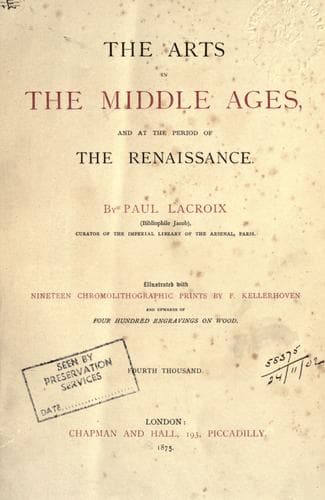
The Arts in the Middle Ages and at the Period of the RenaissanceJacob, P. L.
History
The Arts in the Middle Ages and at the Period of the Renaissance
Jacob, P. L.
Art, Medieval; Art, Renaissance; Middle Ages
In sculptural works, as in every other branch of art, historical
sentiment and faith seemed to die out with the fifteenth century.
Mediæval art was subjected to protest; the desire seemed to be to
re-create beauty of form by going back to the antique; but the
emphatically Christian individuality was no longer reached, and this
pretended _renaissance_, in which even earnest minds were induced to
gratify themselves, only served to exhibit the feeble efforts of an
epoch that sought to reproduce the glories of a vanished age. In the
time of Charles VIII. and Louis XII., Lombarde-Venetian art, the
affected and ingenious imitation of the Greek style, was introduced into
France; it suited the common people, and pleased mediocre intellect. The
sculptors who came at that period to seek their fortunes at the court of
the French kings worked exclusively for the aristocracy, and vied with
one another in adorning, with an ardent infatuation for Italian art, the
royal and aristocratic palaces which were being built or restored in
every direction, such as the Châteaux of Amboise and Gaillon. But they
failed to do any injury to French artists, who still remained charged
with the works of sacred sculptures; and their style became but
slightly, if at all, influenced by this foreign immigration. Even
Benvenuto Cellini himself failed to exercise much effect on the vigorous
schools of Tours, Troyes, Metz, Dijon, and Angers; his reputation and
his works never passed, so to speak, beyond the limits of the court of
France, and the brilliant traces they
[Illustration: Fig. 289.--“St. John the Baptist preaching in the
Desert.” Bas-relief in Carved Wood by Albert Dürer.
(Brunswick Gallery.)]
left behind them were confined to the school of Fontainebleau. Ere long,
some zealous artists from all the principal centres of the French
schools left their country and betook themselves to Italy; among these
were Bachelier of Languedoc, Simon and Ligier Richier of Lorraine,
Valentine Bousch of Alsace, and Jacques of Angoulême, who had the honour
of a victory over his master, Michael Angelo, in a competition of
statuary (many of the former artist’s works now exist in the Vatican);
Jean de Boulogne, and several others. Some of them, after they had
become celebrated on the other side of the Alps, returned to their
native country, bringing back to it their own native genius matured by
the lessons of the Italians. There was, therefore, always a French
school that preserved its individual characteristics, its generic good
qualities and defects, which are so well represented in the sculptures
of the Hôtel du Bourgtheroulde, Rouen (Fig. 290).
[Illustration: Fig. 290.--Bas-relief of the Hôtel du Bourgtheroulde,
Rouen, representing a Scene in the Interview between Francis I. and
Henry VIII., on the Field of the Cloth of Gold.]
Public-domain text, read in full here on John Shaqi.
Reviews
Reviews
No reviews yet
Be the first to share your thoughts on this work.
Elsewhere in the archive
Join the Discussion
Join the discussion
Sign in to leave a comment or review.
Sign InorCreate an account