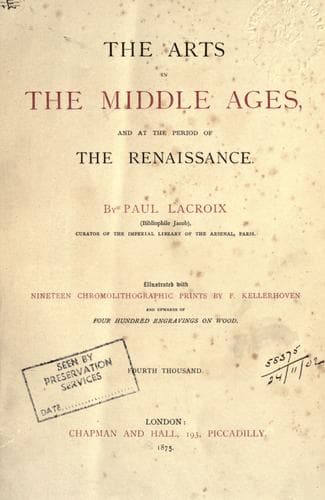
The Arts in the Middle Ages and at the Period of the RenaissanceJacob, P. L.
History
The Arts in the Middle Ages and at the Period of the Renaissance
Jacob, P. L.
Art, Medieval; Art, Renaissance; Middle Ages
The artistic traditions of the ancients in the ninth century are
attested by the manuscripts of Christian Greece, whereof the Imperial
Library, Paris, possesses many magnificent specimens, at the head of
which we must place the “Commentaries of Gregory Nazianzus,” ornamented
with an infinite number of paintings, in which all the resources of
ancient art are applied to the representation of Christian subjects
(Fig. 353). The heads of the characters portrayed are admirably
expressive, and of the finest style; the colouring of the miniatures is
warm and soft; the costumes, the representations of buildings and of the
accessories, offer, moreover, very interesting subjects of study.
Unfortunately, these paintings were executed on a very crumbling
surface, which has in many places peeled off: it is sad to see one of
the most precious monuments of Greek and Christian Art in a deplorable
state of dilapidation.
The masterpiece of the tenth century, which again is due to the artists
of Greece, is a “Psalter, with Commentaries,” belonging also to the
Imperial Library (number 139 among the Greek manuscripts), a work in
which the miniature-painter seems not to have been able to disengage
himself from the Pagan creeds in illustrating Biblical episodes. Two
celebrated manuscripts of the same time, but executed in France, and
preserved in the same collection, show, by the stiffness and
incorrectness of the drawing, that the impetus given by the genius of
Charlemagne had abated: these are the “Bible de Noailles,” and the
“Bible de St. Martial,” of Limoges (Fig. 355).
To speak truly, if in France there was a decadency, the Anglo-Saxon and
Visigothic artists of this period
[Illustration: Fig. 353.--Miniature of the Ninth Century, extracted from
the “Commentaries of Gregory Nazianzus,” representing the consecration
of a Bishop. (Large folio Manuscript in the Imperial Library, Paris.)]
were also very inferior, to judge from a Latin Book of the Gospels of
the tenth century painted in England (Fig. 356); it, however, proves
that the art of ornamenting books had degenerated less than that of
drawing the human figure. Another manuscript with paintings, called
Visigothic, containing the Apocalypse of St. John, gives, in its
fantastic ornaments and animals, an example of the strange style adopted
by a certain school of miniature-painters.
[Illustration: Fig. 354.--Fac-smile of a Miniature drawn with the pen,
taken from a Bible of the Eleventh Century. (Imperial Library, Paris.)]
[Illustration: Fig. 355.--Border taken from the Bible of St. Martial of
Limoges. (Tenth Century.)]
Public-domain text, read in full here on John Shaqi.
Reviews
Reviews
No reviews yet
Be the first to share your thoughts on this work.
Elsewhere in the archive
Join the Discussion
Join the discussion
Sign in to leave a comment or review.
Sign InorCreate an account