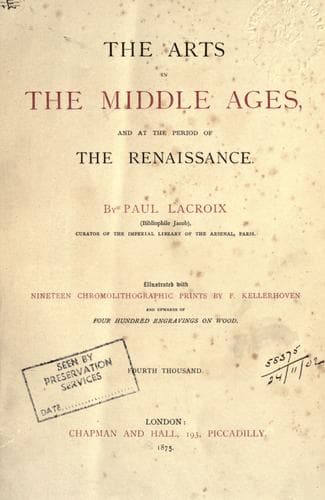
The Arts in the Middle Ages and at the Period of the RenaissanceJacob, P. L.
History
The Arts in the Middle Ages and at the Period of the Renaissance
Jacob, P. L.
Art, Medieval; Art, Renaissance; Middle Ages
Nearly all the French kings, especially the Valois, were passionately
fond of splendid bindings. Catherine de Medicis was such a connoisseur
of finely-bound books, that authors and booksellers, who eagerly
presented her with copies of their works, tried to distinguish
themselves in the choice and beauty of the bindings which they had made
expressly for her. Henry III., who appreciated handsomely-bound books no
less than his mother, invented a very singular binding, when he had
instituted the Order of “Penitents;” this consisted of death’s heads and
cross bones, tears, crosses, and other instruments of the Passion, gilt
or stamped on black morocco leather, and having the following device,
“Spes mea Deus” (“God is my hope”), with or without the arms of France.
It is impossible to associate these superb bindings with the usual and
common work executed at the booksellers’ shops, and under their
superintendence. Some booksellers of Paris and of Lyons, the houses of
Gryphe and Tournes, of Estienne and Vascosan, paid a little more
attention, however, than others of the fraternity, to the binding of
books which they sold to the reading public; they adopted patterns of
dun-coloured calf, in compartments; or white vellum, with fillets and
arabesques in gold, fine specimens of which are now very rare.
At this period Italian bookbinding had reached the most complete state
of decadency, while in Germany and other parts of Europe the old massive
bindings,--bindings in wood, leather, and parchment, with fastenings of
iron or brass,--still held their ground. In France, however, the
binders, whom the booksellers kept in a state of obscurity and
servitude, had not even been able to form themselves into a guild or
fraternity. They might produce masterpieces of their art, but were not
allowed to append their names to their works; and we must come down as
far as the famous _Gascon_ (1641) before we can introduce the name of
any illustrious bookbinder.
[Illustration: Fig. 386.--Banner of the Corporation of
Printers-Booksellers of Autun.]
PRINTING
Who was the Inventor of Printing?--Movable Letters in Ancient
Times.--Block Printing.--Laurent Coster.--_Donati_ and
_Specula_.--Gutenberg’s Process.--Partnership of Gutenberg and
Faust.--Schoeffer.--The Mayence Bible.--The Psalter of 1457.--The
“Rationale” of 1459.--Gutenburg prints by himself.--The
“Catholicon” of 1460.--Printing at Cologne, Strasbourg, Venice, and
Paris.--Louis XI. and Nicholas Jenson.--German Printers at
Rome.--_Incunabula._--Colart Mansion.--Caxton.--Improvement of
Typographical Processes up to the Sixteenth Century.
Public-domain text, read in full here on John Shaqi.
Reviews
Reviews
No reviews yet
Be the first to share your thoughts on this work.
Elsewhere in the archive
Join the Discussion
Join the discussion
Sign in to leave a comment or review.
Sign InorCreate an account