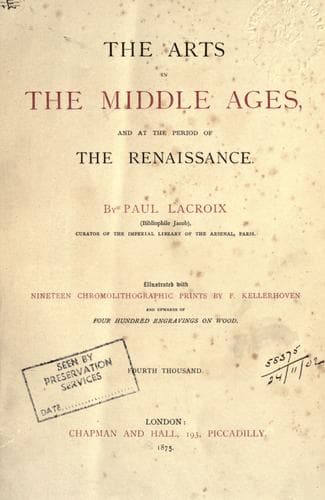
The Arts in the Middle Ages and at the Period of the RenaissanceJacob, P. L.
History
The Arts in the Middle Ages and at the Period of the Renaissance
Jacob, P. L.
Art, Medieval; Art, Renaissance; Middle Ages
Here is an extract from the account given by Adrian Junius, in his Latin
work entitled “Batavia,” of the discovery of printing at Haarlem,
written in 1572:--“More than one hundred and thirty-two years ago there
lived at Haarlem, close to the royal palace, one John Laurent, surnamed
Coster (or governer), for this honourable post came to him by
inheritance, being handed down in his family from father to son. One
day, about 1420, as he was walking after dinner in a wood near the town,
he set to work and cut the bark of beech-trees into the shape of
letters, with which he traced, on paper, by pressing one after the
other upon it, a model composed of many lines for the instruction of his
children. Encouraged by this success, his genius took a higher flight,
and then, in concert with his son-in-law, Thomas Pierre, he invented a
species of ink more glutinous and tenacious than that employed in
writing, and he thus printed figures (_images_) to which he added his
wooden letters. I have myself seen many copies of this first attempt at
printing. The text is on one side only of the paper. The book printed
was written in the vulgar tongue, by an anonymous author, having as its
title ‘Speculum nostræ Salutis’ (‘The Mirror of our Salvation’). Later,
Laurent Coster changed his wooden types into leaden, then these into
pewter. Laurent’s new invention, encouraged by studious men, attracted
from all parts an immense concourse of purchasers. The love of the art
increased, the labours of his workshop increased also, and Laurent was
obliged to add hired workmen to the members of his family, to assist in
his operations. Among these workmen there was a certain John, whom I
suspect of being none other than Faust, who was treacherous and fatal to
his master. Initiated, under the seal of an oath, into all the secrets
of printing, and having become very expert in casting type, in setting
it up, and in the other processes of his trade, this John took advantage
of a Christmas evening, while every one was in church, to rifle his
master’s workshop and to carry off his typographical implements. He fled
with his booty to Amsterdam, thence to Cologne, and afterwards to
Mayence, where he established himself; and calculating upon safety here,
set up a printing-office. In that very same year, 1422, he printed with
the type which Laurent had employed at Haarlem, a grammar then in use,
called ‘Alexandri Galli Doctrinale,’ and a ‘Treatise of Peter the
Spaniard’ (‘Petri Hispani Tractatus’).”
Public-domain text, read in full here on John Shaqi.
Reviews
Reviews
No reviews yet
Be the first to share your thoughts on this work.
Elsewhere in the archive
Join the Discussion
Join the discussion
Sign in to leave a comment or review.
Sign InorCreate an account