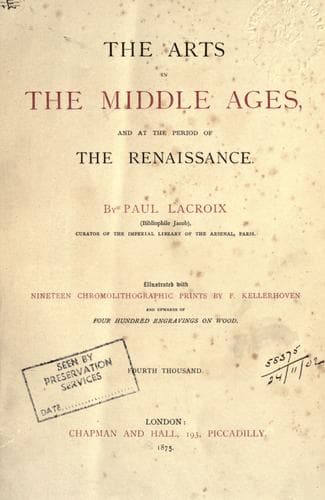
The Arts in the Middle Ages and at the Period of the RenaissanceJacob, P. L.
History
The Arts in the Middle Ages and at the Period of the Renaissance
Jacob, P. L.
Art, Medieval; Art, Renaissance; Middle Ages
And now, are we to suppose that the intercourse between nations and the
transactions of commerce must necessarily have made western Europe
acquainted with the enamelled dishes of Asia, or the _chefs-d’œuvre_ of
the African race in Spain? Or, on the other hand, shall we say that it
was by a spontaneous effort of invention that our forefathers opened up
the road to a new domain of art? In the one case we have the opinion,
deservedly respected, of Scaliger, who affirms the fact, apparently very
significant, that during the Middle Ages there existed in the Balearic
Islands manufactories of pottery of Arab origin; our learned author even
adds, that in accordance with the most probable etymology, the name of
_Majolica_, which was first given to Italian ware (the earliest in the
European revival of the ceramic art), was derived from _Majorca_, the
largest, as we know, of the Balearic Islands, in which locality the
principal manufactory of these pottery wares was situated. But, on the
other hand, a comparative examination of Arab and Italian wares excludes
all idea not only of affiliation, but even of imitation or reminiscence
between them.
In the face of such contradictory coincidence, if we may say so, it
would be as difficult as it would be rash to pronounce an opinion; we
consider it better, while disregarding problematical indications, to
boldly face a train of facts now determined by historical proof.
“At the commencement of the fifteenth century”--we cannot do better than
borrow from M. Jacquemart a passage which he himself took from the
Italian work by Passeri, on Majolica (Pesaro, 1838, in 8vo.)--“Luca
della Robbia, the son of Simone di Marro, apprenticed himself to a
Florentine goldsmith, Leonardo, the son of Giovanni; but disliking the
confinement of a laboratory, he soon became a pupil of the sculptor
Lorenzo Ghiberti, who made the gates of the Baptistry at Florence. His
rapid progress under so able a master placed him in a position, when he
could not have been more than fifteen years old, to undertake the task
of ornamenting a chapel for Sigismond Malatesta, at Rimini. Two years
later, Pietro di Medici, who was having an organ erected in Santa-Maria
dei Fiori, at Florence, directed Luca to execute some marble sculptures
in that church. The fame which he gained by these works drew everybody’s
attention to the young sculptor. Orders reached him in such numbers that
he clearly saw the impossibility of executing them in marble or in
bronze; added to this, he bore with impatience the restraint imposed by
working with such rigid materials, of which the laborious handling
trammelled the flights of his imagination. Soft and plastic clay was a
material far better suited to his readiness of conception. At the same
time, Luca dreamt of the future, and of glory; and thus having in view
the object of executing works which, though less perishable, might be
rapidly executed, he devoted all his efforts to discover a coating which
Public-domain text, read in full here on John Shaqi.
Reviews
Reviews
No reviews yet
Be the first to share your thoughts on this work.
Elsewhere in the archive
Join the Discussion
Join the discussion
Sign in to leave a comment or review.
Sign InorCreate an account