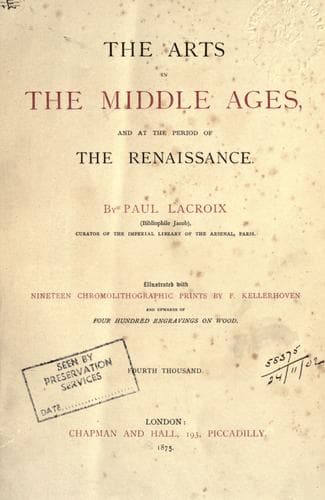
The Arts in the Middle Ages and at the Period of the RenaissanceJacob, P. L.
History
The Arts in the Middle Ages and at the Period of the Renaissance
Jacob, P. L.
Art, Medieval; Art, Renaissance; Middle Ages
would give to clay the polish and the hardness of marble. After many
trials, a varnish made of tin (_étain_), which was white, opaque, and of
a resisting nature, furnished him with the result he hoped for. The art
of producing fine earthenware was discovered, which first received the
name of vitrified clay (_terra invetriata_).
“Luca’s enamel was a most perfect white; he first used it alone for
figures, in semi-relief, which were raised on a blue background. At a
later period he ventured to colour his figures, and Pietro di Medici
was one of the first who encouraged this kind of work for the decoration
of palaces. The fame of this novel art spread with rapidity; all the
churches were anxious to possess some specimen of the master, so that
Luca was soon compelled to associate with himself his two brothers
Ottaviano and Agostino, in order to keep pace with the requirements of
the public. He endeavoured, nevertheless, to extend the application of
his discovery by painting flowers and groups of figures on a smooth
surface; but in the year 1430 death cut short his remarkable career, and
stayed, in the hands of the inventor, the progress of _enamelled
pottery_ (Fig. 35).
[Illustration: Fig. 35.--Enamelled Terra-cotta, by Luca della Robbia.]
“The family of Luca, however, made public the secret of his discovery.
His two nephews, Luca and Andrea, produced some figures and designs of
singular merit in terra-cotta. Luca ornamented the floor of the Loggia
of Raphael. Girolumo, a relative of Luca, come to France, where he
decorated the château of Madrid, in the neighbourhood of Paris. Two
females, Lisabetta and Speranza, added to the renown of the family Della
Robbia.”
Such is the history of the revival, or rather of the creation, of
ceramic art in Italy, as briefly recorded by a man thoroughly acquainted
with the subject. An ancient author, and, moreover, a competent writer,
instances some monuments of an earlier date; among others a tomb at
Bologna, in which were tiles covered with a green and yellow varnish,
and vessels (_écuelles_) of the same kind inserted in the façades or
porticoes of the churches of Pesaro and the abbey of Pomposa. But to the
honour of Luca della Robbia it may be remarked, that these specimens of
an earlier industry differed essentially from his productions; because
the glazing that covered them, the basis of which was lead, was so
transparent, that through it could be seen either the clay or the
colours underneath; whereas the enamel discovered by Luca, the basis of
which was tin, had, on the contrary, for its essential character, an
opacity which may be termed intense. Let us observe, moreover, that in
order to embellish his productions with paintings, Luca was accustomed
to apply colours to the first and general coating, which became fixed by
a subsequent process of baking.
Public-domain text, read in full here on John Shaqi.
Reviews
Reviews
No reviews yet
Be the first to share your thoughts on this work.
Elsewhere in the archive
Join the Discussion
Join the discussion
Sign in to leave a comment or review.
Sign InorCreate an account