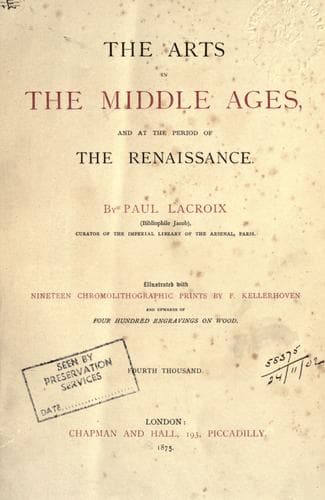
The Arts in the Middle Ages and at the Period of the RenaissanceJacob, P. L.
History
The Arts in the Middle Ages and at the Period of the Renaissance
Jacob, P. L.
Art, Medieval; Art, Renaissance; Middle Ages
And admitting this fact, that the productions of ceramic art were thus
allowed to find admittance, and, as it were, in some measure an equally
distinguished position, amidst plate and objects of precious metals, it
resulted that this new industry, supported by the best artists, soon
became remarkable for works which were at the same time most beautiful
and original.
As something new in history, we find simple pieces of pottery--to give
them their generic name--passing as valuable offerings among the great,
and employed on very many occasions to denote ardent admiration in the
world of courtly gallantry. It is thus we have handed down to us,
principally on cups by renowned masters, portraits of the beauties who
in those times adorned the ranks of the nobility: the Dianas, the
Francescas, the Lucias, the Proserpines, whom their admirers caused to
be portrayed in order to offer them their own likenesses.
It was at Florence, about the year 1410, that Luca della Robbia first
introduced his invention; but as soon as the process became known, the
greater part of the towns of Italy, especially those of Tuscany,
established manufactories, among which a remarkable rivalry soon arose:
Pesaro, Gubbio, Urbino, Faenza, Rimini, Bologna, Ravenna, Ferrara, Citta
Castellana, Bassano, Venice, emulated each other, and almost all
succeeded in giving, as it were, an individual character to their
productions.
Pesaro--the place were the earliest workshops of ornamental pottery in
Italy were seated, and the processes of which (derived from Luca della
Robbia) seem to have blended with the ancient Spanish, or
_Majorquaises_--presents to us a design of a rather harsh and stiff
character. “The outlines of figures,” adds M. Jacquemart, “are drawn in
manganese black, the flesh is the colour of the enamel, and the drapery
alone is of uniform tint.”
It was at Pesaro that the celebrated Lanfranco flourished. The ceramic
museum of Sèvres has two of his pieces: it was he who invented the
method of applying gold to earthenware, at a time when the early
processes of ornamenting this manufacture had ceased to be employed, and
had given place to delicate paintings, which, although no longer
executed by the most renowned artists of Italy, were nevertheless the
work of intelligent pupils who had received the benefit of their
teaching and example.
The manufactory at Gubbio had for its founder Giorgio Andreoli, who,
both as a sculptor and an artist in majolica, executed works as
remarkable in form as in effect. “The palette of mineral colours adopted
by Andreoli was the most perfect of the period; and coppery yellows,
ruby reds, are frequently used in his works.” There are still extant
some works signed by this _master_ (a title officially conferred on him
by a patent of nobility); one is a slab in the Sèvres collection, and
another a tablet representing the Holy Family.
Public-domain text, read in full here on John Shaqi.
Reviews
Reviews
No reviews yet
Be the first to share your thoughts on this work.
Elsewhere in the archive
Join the Discussion
Join the discussion
Sign in to leave a comment or review.
Sign InorCreate an account