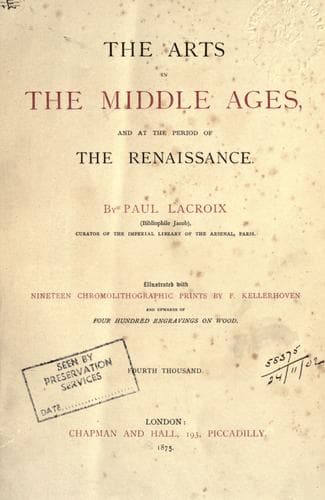
The Arts in the Middle Ages and at the Period of the RenaissanceJacob, P. L.
History
The Arts in the Middle Ages and at the Period of the Renaissance
Jacob, P. L.
Art, Medieval; Art, Renaissance; Middle Ages
“After the death of Palissy, in 1589, the art which he had created
insensibly declined, until soon it almost completely disappeared in
France.”
This latter remark has reference to the style which was peculiarly of
Palissy’s own invention, and not to the production of ceramic works
generally; though the art failed not to give evidence of a certain
vitality,
[Illustration: Fig. 42.--Enamelled Dish, by Bernard Palissy. (Museum of
the Louvre.)]
it employed as guides or models the fanciful examples of Italian ware,
in preference to the really masterly specimens of the French artist.
Among the different centres of manufacture which, at that period, were
deserving of notoriety, we must specially name Nevers, whence came
numerous examples characterised by subjects taken from biblical
narratives, as well as from Roman and contemporaneous times; Rouen,
where the manufacture probably was not of an earlier date than the
beginning of the seventeenth century, and which evidently had to provide
its full supply of dishes for the table when, owing to the heavy
expenses of war, the courtiers, following the example of Louis XIV.,
sent their plate to the mint, and “_se mirent en faïence_,” “took to
earthenware,” as Saint-Simon says. Lastly we have Montreuil-sur-Mer,
which, if we are to credit the specimens collected in the district by M.
Boucher de Perthes, one of our most learned antiquarians, possessed a
manufactory that produced some remarkable “open-work” vases.
[Illustration: Fig. 43.--Four-handled Water-jug. German ware of the
Sixteenth Century.]
[Illustration: Fig. 44.--Egg-shaped Coffee-pot. German ware of the
Sixteenth Century.]
Let us also mention the Dutch pottery, called _Delft ware_, which, in
the beginning of the seventeenth century, began to find a place on all
sideboards and dressers. According to M. Brongniart, these came from a
manufactory founded prior, perhaps, to the sixteenth century. We also
instance the fine earthenware, in relievo, manufactured with undoubted
ability in Germany, especially in the town of Nuremberg. In the Louvre
and in the Cluny Museums may be seen magnificent specimens of enamelled
slabs and vases of architectural forms, ornamented with figures.
Majolica was equally esteemed on the banks of the Rhine. Many specimens
are found, dating from the latest years of the sixteenth century, in
which identity of form or similarity of _sigles_ (earths or clays) to
primitive works had led to their being, at first, classified among
Italian majolica. However, the majority of these examples, ornamented
with escutcheons and arabesques, combined generally with Latin or German
inscriptions, bear on the reverse a cipher in Gothic letters, leaving no
doubt as to the artist’s country.
Now a word on a question we ought not to pass in silence, though it yet
remains unanswered, and doubtless will never be explained.
Public-domain text, read in full here on John Shaqi.
Reviews
Reviews
No reviews yet
Be the first to share your thoughts on this work.
Elsewhere in the archive
Join the Discussion
Join the discussion
Sign in to leave a comment or review.
Sign InorCreate an account