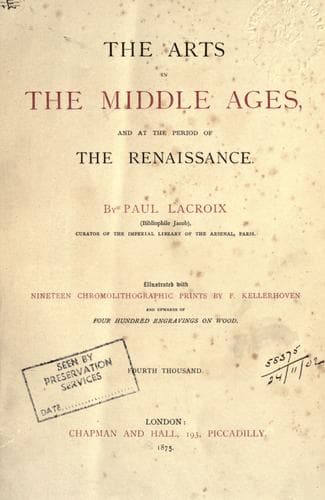
The Arts in the Middle Ages and at the Period of the RenaissanceJacob, P. L.
History
The Arts in the Middle Ages and at the Period of the Renaissance
Jacob, P. L.
Art, Medieval; Art, Renaissance; Middle Ages
De la Noue, an eminent Huguenot officer of the time of Charles IX.,
says, in his “Discours Militaires”--“The penetrating power of pikes and
arquebuses has very naturally led to the adoption of armour stronger and
more capable of great resistance than formerly. It is now so heavy that
one is laden with anvils rather than protected by armour. Our
men-at-arms and light cavalry in Henry II.’s time presented a much finer
appearance, with their helmets, their brassarts, tassets,[10] and the
morion,[11] carrying the lance with a flag; their armour was not so
heavy but that a strong man was able to support its weight for
twenty-four hours; but those of the present day are so ponderous that a
young knight of thirty has his shoulders quite crippled.”
Thus, in endeavouring to make the resistance of armour keep pace with
the improvement in new warlike engines, they rendered it useless;
because the weight was intolerable, especially in warm weather, during
long marches, or in lengthened combats. Having vainly tried to make
suits of armour invulnerable, men began to leave off wearing such
portions as were of minor importance, which by degrees were entirely
discontinued. Under Louis XIII. we see armour undergoing further
modifications, but of fashion rather than of utility: finally, there is
every reason to think that the magnificent armour presented by the
Republic of Venice to Louis XIV., in 1668, and which is now to be seen
in the Museum of Artillery in Paris, was one of the latest sets made in
Europe.
Let us now retrace our steps to examine a series of arms, the gradual
adoption of which was destined to completely change the art of warfare.
It is now the almost universal opinion that the invention of
gunpowder,--assumed to have been discovered in 1256, or at all events
its application to artillery, which first dates from 1280,--is due to
Berthold Schwartz, an Augustin friar, born at Fribourg. Some writers,
however, make these dates a century later, and affirm that powder and
cannons were first known from 1330 to 1380. Nevertheless, the employment
of artillery only became general during the wars of Charles-Quint and of
Francis I., that is, towards 1530, or two centuries after its
invention.
But perhaps in place of giving, as we have done, the unconditional
acceptation to the word _artillery_ which it now has, we ought perhaps
to have said artillery used with gunpowder; for long before the
invention of gunpowder the word _artillery_ was employed when speaking
of all machines or engines of war (Fig. 62). Thus in the middle of the
thirteenth century we find among the _personnel_ of the _artillery_ a
grand master of the crossbow men, masters of the engines, of the
cannoniers (the word _cannon_ was even then applied to the tube forming
one of the principal portions of an engine for hurling projectiles), and
in 1291 we see Philip the Fair appointing a grand master of the
artillery of the Louvre.
Public-domain text, read in full here on John Shaqi.
Reviews
Reviews
No reviews yet
Be the first to share your thoughts on this work.
Elsewhere in the archive
Join the Discussion
Join the discussion
Sign in to leave a comment or review.
Sign InorCreate an account