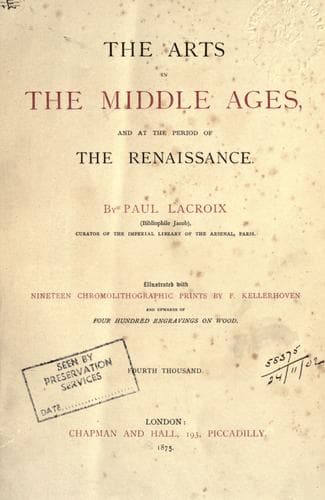
The Arts in the Middle Ages and at the Period of the RenaissanceJacob, P. L.
History
The Arts in the Middle Ages and at the Period of the Renaissance
Jacob, P. L.
Art, Medieval; Art, Renaissance; Middle Ages
To that period belongs the famous gold altar of the basilica of St.
Ambrose of Milan, executed in 835, by order of Archbishop Angilbert, by
Volvinius; and which, notwithstanding its immense intrinsic value, has
come down to our time. “The four sides of this monument,” says M.
Labarte, “are of extreme richness. The front, entirely of gold, is
divided into three panels by a border of enamel. The centre panel
represents a cross of four equal projections, formed by fillets of
ornaments in enamel, alternating with precious stones uncut but
polished. Christ is seated in the centre of the cross. The symbols of
the Evangelists occupy its branches. Three of the Apostles are placed in
each angle. All these figures are in relief. The right and left panels
contain each six bas-reliefs, the subjects of which are taken from the
life of Christ; they are encircled by borders of enamels and precious
stones alternately disposed. The two sides, in silver relieved with
gold, exhibit very rich crosses, treated in the same style as the
borders. The back, which is also of silver relieved with gold, is
likewise divided in three large panels; that in the centre contains four
medallions, and each of the others six bas-reliefs, of which the life of
St. Ambrose supplied the subjects. In one of the medallions of the
centre panel is seen St. Ambrose receiving the gold altar from the hands
of Archbishop Angilbert; in the other, St. Ambrose is giving his
benediction to Volvinius, the master goldsmith (_magister faber_), as he
is designated in the inscription transmitting to us the name of the
author of this work, of which no description can give an exact idea.”
It was not Italy alone which possessed skilful goldsmiths, and
encouraged them. We have in particular, among other enlightened and
active supporters of ecclesiastical gold-work, a succession of the
bishops of Auxerre, to whom must be added Hincmar, bishop of Rheims, who
caused a splendid shrine to be made for the relics of the illustrious
patron of his church. It was cased in plates of silver, and statues of
twelve bishops adorned its borders.
But, notwithstanding all its artistic magnificence, the jewellery of the
West could only appear to be the reflex of the wonders produced at the
same epoch by the goldsmiths of the East, or the Byzantines, to adopt a
term generally sanctioned.
One of the most curious specimens of Byzantine art, preserved in Russia,
is a gold reliquary lined with a plate of silver, in the centre of which
is an embossed representation of the Crucifixion. Above the head, on a
gilt nimbus, is an inscription in Greek, “Jesus Christ, King of Glory.”
This treasure, remarkable for its extreme finish, is covered with a
mosaic of precious stones of different colours, in partitions of gold;
the cross being quartered in enamel, with silver filigree. At the back
the names of the archimandrite Nicolos are engraved. It is a work of the
tenth century, and was found in the Iberian monastery on Mount Athos.
Public-domain text, read in full here on John Shaqi.
Reviews
Reviews
No reviews yet
Be the first to share your thoughts on this work.
Elsewhere in the archive
Join the Discussion
Join the discussion
Sign in to leave a comment or review.
Sign InorCreate an account