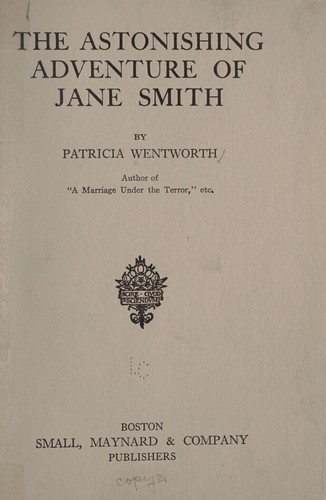
The Astonishing Adventure of Jane SmithWentworth, Patricia
General
The Astonishing Adventure of Jane Smith
Wentworth, Patricia
Adventure stories; Cousins -- Fiction; Detective and mystery stories
When an express rushed through, the whole structure shook and clouds of
white steam blotted out everything. It was when the steam was clearing
away, and the roar of the receding train was dying down, that Anthony
noticed another local running in to the Withstead platform. He bent over
the rail and watched the passengers get out—just a handful. There was a
young woman with two children, two farmers, three or four nondescript
women, and a big man with a suit-case. Anthony looked at the big man and
went on looking at him. Something about him seemed vaguely familiar. The
man came along the platform and began to mount the steps that led up to
the bridge. Half-way up he put down his suit-case, took off his hat for
a moment as if to cool himself, and stood there looking up. Then he
replaced his hat, shifted the suit-case to the other hand, and came up
the rest of the steps. He seemed hot.
He passed Anthony and went down the steps on to the London platform.
Anthony followed him.
When the big man stood still and looked up, eight years were suddenly
wiped out. Memory is a queer thing, and plays queer tricks. What
Anthony’s memory did was to set him down in the year 1912, in the
gallery of a hall in Chicago. There was a packed and rather vociferous
audience. There was a big man on the platform, a big man who seemed hot.
His speech was, in fact, of a sufficiently inflammatory nature to make
any one feel hot. It breathed fire and fury. Its rolling eloquence must
have involved a good deal of physical exertion. Suddenly, after a
period, the speaker stopped and looked up at the gallery for applause.
It came like a veritable cyclone. The meeting was subsequently broken up
by the police.
Anthony remembered that the speaker’s name was Molloy. If Mr. Molloy had
come from Withstead, it occurred to Anthony that his destination would
probably be of interest.
The London train was due in ten minutes. When it came in, Molloy got
into a third-class carriage, and Anthony followed his example.
It was at seven-thirty on Sunday morning that Mrs. March’s cook, who was
sweeping the hall, was given what she afterwards described as a turn by
the arrival of an odd-looking man who would give no name and insisted on
seeing her master.
“Awful he looked with that ’orrid scar and his ’air that wild, and not
giving me a chance to shut the door in his face, for he pushes in the
moment I got it open—that’s what give me the worst turn of all—and walks
into the dining-room as bold as brass, and says, ‘I want to see Captain
March—and be quick, please.’”
When Henry came into the dining-room he shut the door behind him very
quickly and looked as if he also had had a turn.
“Good Lord, Tony, what’s happened?” he said.
“Nothing,” said Anthony, with nonchalance.
“Then in Heaven’s name, why are you here?”
“I’m through, that’s all. You can’t say I didn’t give notice.”
“It’s not a question of what I say, it’s what Piggy’ll say.”
Public-domain text, read in full here on John Shaqi.
Reviews
Reviews
No reviews yet
Be the first to share your thoughts on this work.
Elsewhere in the archive
Join the Discussion
Join the discussion
Sign in to leave a comment or review.
Sign InorCreate an account