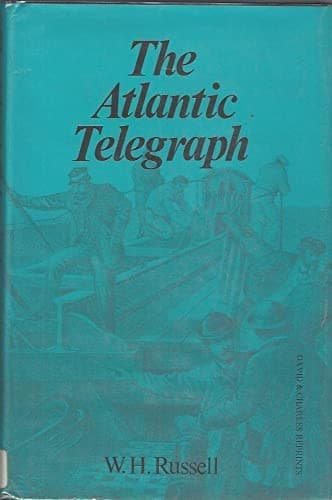
The Atlantic Telegraph (1865)Russell, William Howard, Sir
History
The Atlantic Telegraph (1865)
Russell, William Howard, Sir
Transatlantic cables
The directors also gave notice that they intended to seek authority from
the shareholders to issue such amounts of new capital as may be required
for the construction and laying of a second Atlantic Telegraph Cable
under powers of their Act of Parliament, and to attach to such capital
such privileges and such advantages and conditions as might be
determined. The Right Hon. J. S. Wortley, chairman, who has exhibited
unshaken confidence and untiring energy in the post he occupies, had a
difficult task before him, but even then he could exhort his hearers to
courage and perseverance. As he well said, “But there are two things
from which we may derive considerable consolation. This great enterprise
has been the subject of discussion in every civilised nation in the
world. The eyes of science have been fixed upon it; and the acuteness of
criticism has been brought to bear on it. We have had our detractors,
and there have been sceptics; and what are the two main points on which
they have founded their scepticism? One is, that the great depth of
nearly three miles must bring extraordinary pressure on the Cable, must
injure it by perforating the covering, and must in fact destroy the
insulation. The other point was the impossibility, as they contended, of
communicating intelligible signals through so great a length, or ‘leap’
as they term it, as 1,600 miles. But we had a scientific committee, who
made experiments, and who assured themselves that there was nothing in
either of those objections; and now we have in addition the much more
practical and valuable proof of experience. What are the facts? Some
days before the interruption of the messages the Great Eastern passed
over the deepest portion of the ocean (with one slight exception) which
we have to traverse between Europe and America. She passed safely over a
depth of 2,400 fathoms, telegraphing perfect signals. This entirely
disproves and refutes the first objection and doubt which existed in the
minds of those sceptical gentlemen, because the Cable was laid in great
depths, varying from 1,500 to 2000, fathoms, and even in 2,400 fathoms;
and so far from the great pressure at that depth injuring the Cable, the
Company’s signals appear from their telegrams to have improved every
yard they went; and the signals through 2,400 fathoms of water were as
perfect as, if not more perfect than, those at a less depth. That is in
confirmation of the old Cable having worked at those depths. Then I say
that our scientific committee, and those who said that the pressure
would not have an injurious effect, have been fully borne out; and that
the result has proved that, so far from injuring it, pressure improves
the Cable. In spite of these facts, I see here a communication from a
gentleman to one of the public journals only yesterday, in which he
says, that looking at the pressure of a column of water equal to so many
atmospheres, it must destroy the Cable; and he adds with confidence,
Public-domain text, read in full here on John Shaqi.
Reviews
Reviews
No reviews yet
Be the first to share your thoughts on this work.
Elsewhere in the archive
Join the Discussion
Join the discussion
Sign in to leave a comment or review.
Sign InorCreate an account