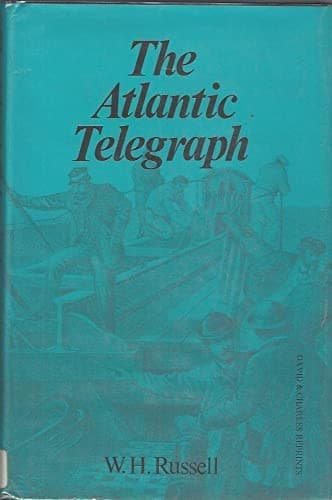
The Atlantic Telegraph (1865)Russell, William Howard, Sir
History
The Atlantic Telegraph (1865)
Russell, William Howard, Sir
Transatlantic cables
It will be seen that circumstances have thus enabled the Board to effect
a very considerable economy in the Company’s present operations.
It would no doubt have been a most gratifying circumstance if the recent
accidents had not happened, and to the Directors this occurrence has
been a grievous disappointment, but the circumstances surrounding the
expedition and the increased confidence which, in spite of temporary
discomfiture, has been given to the future of Deep-sea Cables, has
enabled the Board to effect a new contract for the repair of the old
Cable and for the submersion of a new one during 1866, on terms so
satisfactory that if both these operations should succeed, the Company
will actually be in possession of two efficient Cables for a less amount
by 100,000_l._ than they would have been obliged to expend if the Cable
of this year had been successful and the second Cable had been required
to be purchased separately.
But the carrying out of this contract, so advantageous to the Atlantic
Telegraph Company, involves the strenuous efforts of the Directors to
raise an amount of money ranging from a minimum of 250,000_l._ to a
maximum of 500,000_l._ in cash.
It is impossible that the Great Eastern ship could go to sea again this
year to mend the existing Cable, and therefore such an operation, as a
separate adventure, must be put out of the question, and even if
undertaken separately would in itself involve an expenditure of some
120,000_l._, whereas for a sum of 500,000_l._ the Contractors are
willing to make and lay a new Cable next year in addition to the
restoration of the old one; they depending entirely upon success for
profit.
The question which has had to be considered by the Directors in the
interest of the Shareholders has been how best they might be enabled to
raise this money.
The Eight per Cent. Preference Shares, though far below their real
value, stand at 2_l._ 5_s._ per share, and if the Company were to adopt
the alternative of winding-up its affairs, their intrinsic worth would
not be 10_s._ per share.
The expenditure of the new money will certainly create fresh property,
and probably resuscitate the old.
By its means the existing Eight per Cent. Preference Stock will
doubtless be placed at par in the market before the sailing of the ship
next year.
The Directors are, however, compelled to offer an inducement to those
who are willing to come in and assist to place in that position the
Company’s, at present, sinking property.
Acting under advice, and believing in the very large profits that
undoubtedly await this Company when successful, they desire to offer a
first dividend of 12 per cent., with participation in profits, after 8
per cent. has been paid upon the existing preference shares and 4 per
cent. upon the old capital, to those who consent to supply the requisite
funds.
Public-domain text, read in full here on John Shaqi.
Reviews
Reviews
No reviews yet
Be the first to share your thoughts on this work.
Elsewhere in the archive
Join the Discussion
Join the discussion
Sign in to leave a comment or review.
Sign InorCreate an account