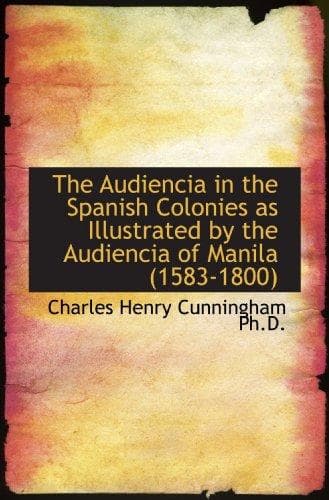
The Audiencia in the Spanish Colonies: As illustrated by the Audiencia of Manila (1583-1800)Cunningham, Charles Henry
History
The Audiencia in the Spanish Colonies: As illustrated by the Audiencia of Manila (1583-1800)
Cunningham, Charles Henry
Philippines -- History -- 1521-1812; Spain -- Colonies -- Administration
An oidor was designated by the president to make periodical inspections
in the provinces. This official had to attend to a variety of matters
while on visits of inspection. He was required to make a census
of the towns, and inquire into the prosperity of the inhabitants;
to audit the accounts of the town officials, and to see whether the
provincial governor or magistrate had been faithful in the execution
of his duties. He was supposed to visit the encomiendas and note the
treatment of the Indians thereon, to find out whether the natives were
properly and sufficiently instructed, or whether they were permitted
to remain in idolatry and idleness. He inspected the churches and
monasteries, seeing that they contained the requisite number of
religious and no more, and noting whether the natives under the charge
of the ecclesiastics were well treated. In the same way he inspected
the curacies of the towns. The visiting oidor was especially required
to give careful attention to the corregidores and alcaldes mayores,
inspecting their judicial and administrative activities and holding
them responsible for any irregularities, especially with regard to
the treatment of the Indians. The visitor was required to inspect
inns and taverns, to ascertain whether they observed the regular
tariffs, and whether the drugs sold in the provinces were of good
quality. He also inspected highways and bridges. If the visitor
found anything wrong he was authorized to take immediate steps, on
his own responsibility, to remedy the defects, reporting any action
taken to the audiencia without delay. As seen in the last chapter,
the immediate consequence of the visit was frequently the residencia
of the official inspected. The visitor was provided with sufficient
funds to defray his expenses, so that he would not be a burden on the
encomenderos or Indians. The president of the audiencia was forbidden
to order visits to the same province more frequently than once every
three years, unless, after an investigation, such action was declared
necessary by vote of the acuerdo. [303]
The audiencia exercised supervision over certain matters of church
finance. These included tithes, the funds of temporalities, and of
certain charitable societies, and jurisdiction over the adjustment of
estates and properties left by deceased prelates. In connection with
the latter was the duty of auditing the accounts of benefices which
were subject to the royal patronage whenever a transfer of occupants
was made. These matters, though miscellaneous in their character,
and accordingly pertinent here, may be reserved for a subsequent
chapter which will be dedicated to a discussion of the relations of
the audiencia and the Church.
Public-domain text, read in full here on John Shaqi.
Reviews
Reviews
No reviews yet
Be the first to share your thoughts on this work.
Elsewhere in the archive
Join the Discussion
Join the discussion
Sign in to leave a comment or review.
Sign InorCreate an account