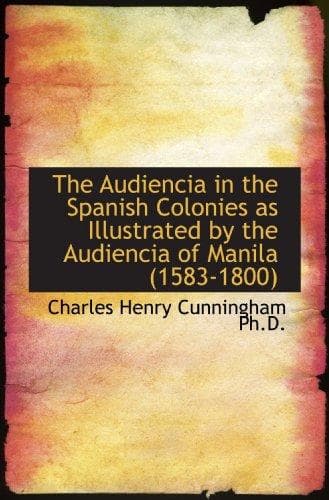
The Audiencia in the Spanish Colonies: As illustrated by the Audiencia of Manila (1583-1800)Cunningham, Charles Henry
History
The Audiencia in the Spanish Colonies: As illustrated by the Audiencia of Manila (1583-1800)
Cunningham, Charles Henry
Philippines -- History -- 1521-1812; Spain -- Colonies -- Administration
The first law providing for a special administrator was proclaimed
at Valladolid on April 16, 1550. It stated that many of the heirs of
persons who died in the colonies had been defrauded of their rightful
dues by the carelessness, omission, illegal procedure, and usurpation
of the ministers who had diverted the property to their own uses; this
condition of affairs made reform imperative. Viceroys and presidents
of royal audiencias, while retaining power of removal for cause,
were commanded henceforth to name, at the beginning of each year,
an oidor from the local audiencia to act as juez de difuntos. [320]
This judge was authorized to collect, administer, rent, sell, and
have general supervision over the property of deceased persons to
the same extent that the audiencia previously had. The acts of the
judge were appealable to the audiencia of the district wherein he
officiated. On December 15, 1609, a law was proclaimed by Philip
III which extended the term of this judge from one to two years. The
early laws provided no extra salary for the juez de difuntos. It was
prescribed that his decisions should be respected by the audiencia and
by the other officials of the government, the viceroys and presidents
being especially instructed not to allow any other official to usurp
his functions.
In case the juez de difuntos should fail to execute his duties,
or should exceed his powers, it was the duty of the fiscal to bring
the abuse to the attention of the audiencia, and that tribunal was
supposed to see that the proper methods were enforced. The jurisdiction
of this special magistrate was to extend to the settling of the
estates of intestates, and of testates leaving property to persons in
Spain. His authority was valid over the property of deceased officials,
merchants, and encomenderos, and it might be extended to the cases
of foreigners. He also assisted in the disposal of property left
by clerics. When the latter died intestate, the proceeds of their
estates were added to the fund known as the bienes de difuntos. No
distinction was made between property left by them and that left
by civil employees of the government or private citizens. If these
priests had made testaments, it was the duty of the juez de difuntos
to see that the property reached the donees without the interference
of the prelates. [321]
Public-domain text, read in full here on John Shaqi.
Reviews
Reviews
No reviews yet
Be the first to share your thoughts on this work.
Elsewhere in the archive
Join the Discussion
Join the discussion
Sign in to leave a comment or review.
Sign InorCreate an account