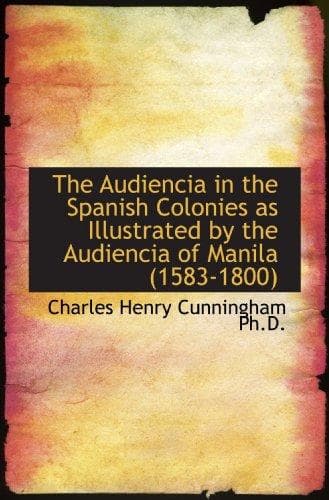
The Audiencia in the Spanish Colonies: As illustrated by the Audiencia of Manila (1583-1800)Cunningham, Charles Henry
History
The Audiencia in the Spanish Colonies: As illustrated by the Audiencia of Manila (1583-1800)
Cunningham, Charles Henry
Philippines -- History -- 1521-1812; Spain -- Colonies -- Administration
was so frequently disregarded that it was practically a dead-letter.
Typical of the governor's authority over all the officials of the
colony, and incidentally over the oidores, was his power to grant
or withhold permission to marry within the colony. The earlier laws
on this subject absolutely forbade viceroys, presidents, oidores,
alcaldes, or their children to marry within their districts. [407]
Deprivation of office and forfeiture of salary were the penalties
for infraction of these regulations. These laws were followed by
others which required the president (viceroy or governor) to report
immediately to the Council the case of any magistrate guilty of
violating the law forbidding the marriage of officials. [408] It
was not until 1754 that a law was promulgated providing for special
marriage dispensations to be granted by the Council of the Indies upon
the recommendation of the president of the audiencia. [409] In 1789
the president was authorized to concede permission to accountants
and treasury officials, but not to oidores. [410] The prohibition
was applied to magistrates until 1843, and the only condition under
which they were permitted to marry within the colony was by virtue
of the express permission of the supreme tribunal in Spain. In 1848,
the president of the audiencia was authorized to grant marriage
licenses to magistrates on condition that the contracting parties
were "of equal quality, customs, and of corresponding circumstances,"
permission having first been obtained from Spain, [411] the president
alone passing upon the requisite qualifications.
The chief reason for the restrictions and prohibitions placed
on the marriage of magistrates seems to have been the conviction
that officers of justice would compromise themselves by marriage,
acquiring vast numbers of relatives and dependents, thereby making
it impossible to render impartial decisions or administer justice as
evenly and dispassionately as they would were they not so familiarly
known in their districts. It was also necessary to prevent officials
from lowering their dignity by union with natives and half-castes. The
marriage of officials with natives of the Philippines was not regarded
with favor at any time by the Spanish government.
Public-domain text, read in full here on John Shaqi.
Reviews
Reviews
No reviews yet
Be the first to share your thoughts on this work.
Elsewhere in the archive
Join the Discussion
Join the discussion
Sign in to leave a comment or review.
Sign InorCreate an account