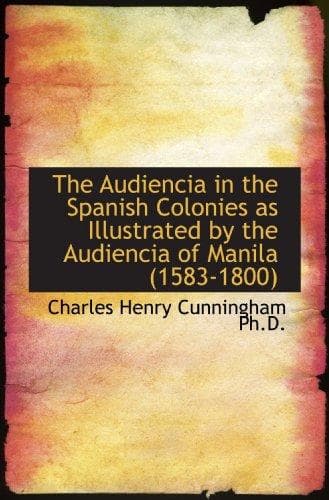
The Audiencia in the Spanish Colonies: As illustrated by the Audiencia of Manila (1583-1800)Cunningham, Charles Henry
History
The Audiencia in the Spanish Colonies: As illustrated by the Audiencia of Manila (1583-1800)
Cunningham, Charles Henry
Philippines -- History -- 1521-1812; Spain -- Colonies -- Administration
It is clear that the power of the new governor was derived chiefly
from his status as royal vicepatron, acting in conjunction with the
archbishop. This power Vargas had formerly employed in co-operation
with the audiencia, and thereby both had gained their victory over
the prelate before the arrival of the new governor. Curuzaelegui used
the same authority to recall Pardo; and in so doing he was probably
the only governor in the history of the Islands who ever supported
a prelate against the advice of the audiencia. The combination of
a governor and an audiencia was much more frequent, as we shall
see. The position of the governor was strengthened, also, by his
commission to conduct the residencia of Vargas, and the respect
which the audiencia had for him was increased by the fact that in
judging the ex-governor's misdeeds he was also authorized to hold
the oidores responsible for all their official opinions and acts
in acuerdo with the disgraced governor. [527] Another source of the
governor's strength was to be found in the royal instructions which
he carried with him to stop the quarrels previously existing in the
colony. The oidores very prudently submitted to the new governor,
and therefore, for a time, they were patronized by the latter, who
utilized their intimate knowledge of local affairs to aid him in
obtaining control of the government and familiarizing himself with
it. Meanwhile he literally held the residencia over their heads.
The attitude of the new governor toward the audiencia during the first
six months may be described as conciliatory. That he did not act with
entire independence of it is attested by the fact that when Vargas
appealed to the tribunal against the ecclesiastical penalties imposed
by the archbishop, the governor signed the act ordering the absolution
of his predecessor. When the archbishop persisted in his intention
to humiliate Vargas on the ground that the Inquisition demanded such
action, the new governor threatened again to expel the prelate if
he did not desist. [528] His pacificatory efforts also resulted in a
temporary cessation of the hostility between the archbishop and the
audiencia; he held private conferences with the oidores, manifesting
repeatedly his determination to proceed harmoniously with them. As
a result of this treatment, the magistrates were emboldened to urge
that the return of the prelate was contrary to law, and inconsistent
with all precedent.
Public-domain text, read in full here on John Shaqi.
Reviews
Reviews
No reviews yet
Be the first to share your thoughts on this work.
Elsewhere in the archive
Join the Discussion
Join the discussion
Sign in to leave a comment or review.
Sign InorCreate an account