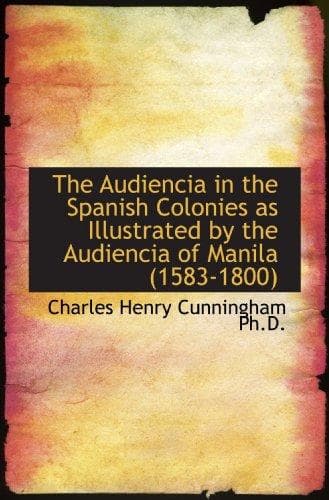
The Audiencia in the Spanish Colonies: As illustrated by the Audiencia of Manila (1583-1800)Cunningham, Charles Henry
History
The Audiencia in the Spanish Colonies: As illustrated by the Audiencia of Manila (1583-1800)
Cunningham, Charles Henry
Philippines -- History -- 1521-1812; Spain -- Colonies -- Administration
The replies given by the orders on this occasion involve important
laws and principles which underlie the nature of the audiencia and its
relation to the governorship. The archbishop, in a subsequent report to
the king on the government of Bustamante, stated that all the religious
authorities in the colony advised the governor against the destruction
of the audiencia, and questioned the authority of the prelate to
constitute another. [538] It seems, however, from an investigation
of the letters, that the Jesuits counseled the governor in favor of
the proposed action. The reasoning of the Jesuit theologians was as
follows: there should be retained in the Philippines, according to
the Recopilación de Indias, [539] four oidores and a fiscal for the
proper administration of justice, and if the fiscal were the only
remaining member of the old audiencia he would become an oidor in
case of a vacancy, by virtue of the recognized law. [540] Owing to
the multitudinous duties of the oidores and to the great importance
of the audiencia, great harm would arise if there were not enough
magistrates. Since the governor's jurisdiction extended to all
departments of government, it was the opinion of the Jesuits that
it was incumbent on him to take such steps as might seem necessary
for the preservation of the government. This was specially imperative
since it was his duty to see that there was no delay or neglect in the
administration of justice. Inasmuch as the audiencia was indispensable
to him as vicepatron in its jurisdiction over ecclesiastical affairs,
and because of its consultative powers in all affairs of government
and finance, the governor should have the right to create an audiencia,
if one did not exist, or if the members who were regularly constituted
by royal appointment were incapacitated from service. [541]
The opinion of the Dominicans of the University of Santo Tomás differed
widely from that advanced by the Jesuits. Their advice coincided
with that of the archbishop, being to the effect that it would not be
convenient to qualify one of the ministers alone, but that all of them
should be restored to the audiencia. This meant that Bustamante should
recede from his position, remove all the oidores from prison, and
accept them as an audiencia. If the three oidores deserved punishment
it would be unfair to the remaining two magistrates to exempt one,
and such action would lay the governor open to charges of inconsistency
and favoritism. The Dominicans contended that only the king in council
could suspend or remove oidores, and that such power was not given
to any other authority, not even to a viceroy. [542] Though
in Sicily and Naples this right is granted, in the Indies the
contrary is true, because only the king that appointed them may
suspend them, and it is commanded that the viceroys must not
interfere with or impede their jurisdiction. [543]
Public-domain text, read in full here on John Shaqi.
Reviews
Reviews
No reviews yet
Be the first to share your thoughts on this work.
Elsewhere in the archive
Join the Discussion
Join the discussion
Sign in to leave a comment or review.
Sign InorCreate an account