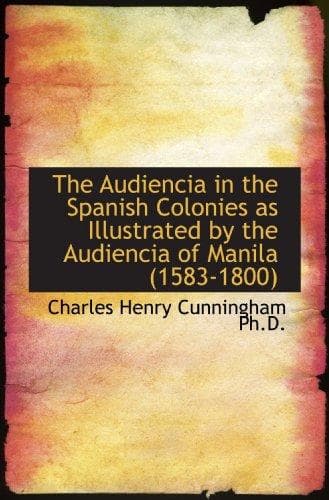
The Audiencia in the Spanish Colonies: As illustrated by the Audiencia of Manila (1583-1800)Cunningham, Charles Henry
History
The Audiencia in the Spanish Colonies: As illustrated by the Audiencia of Manila (1583-1800)
Cunningham, Charles Henry
Philippines -- History -- 1521-1812; Spain -- Colonies -- Administration
The Court of Madrid was unable to remedy these defects in colonial
administration. It could and did discipline the officials by sending
an occasional visitor, or by forcing them to give vigorous residencias,
but these punishments only led to greater abuses in order to reimburse
themselves for the fines which they had to pay. Officials were able
to send away large sums of money and consignments of merchandise,
and then, after having paid liberal penalties, they returned
to Spain and lived in comfortable retirement. Acceptance of the
office of governor, oidor, corregidor, or alcalde mayor was made
with a foreknowledge that disputes would arise, enemies would bring
accusations, and punishments would be meted out, whether deserved or
not. This condition led to the abuses which have been noted, and the
recriminations and struggles between authorities. From the view-point
of these officials the Philippines were neither governed for the good
of the natives nor for the residents, nor for the honor of Spain, nor
for the propagation of the Catholic religion, but merely for the profit
and advancement of those who were on the ground to take advantage
of their opportunities. They were struggles for profit; pure and
simple contests between the officials either to get all the proceeds
possible from their offices or to keep other officials from getting
all, and thus to get a share for themselves. There were exceptions,
of course, to the conditions and circumstances just noted. Some
able and well-intentioned men came to the Islands, as came to all of
Spain's colonies, among whom may be mentioned Oidor Antonio de Morga,
the fiscal, Francisco Leandro de Viana, and Governors Anda y Salazar,
Basco y Vargas, Aguilar, Enrile, and others of the nineteenth century
when opportunities for gain were somewhat diminished. Some of these
officials erred on the side of over-strictness, and their efforts to
restrain the avarice of their colleagues and to infuse the spirit of
honesty into their administrations united the opposition and led to
battles as violent and unrelenting as those which were fought when
all parties were dishonest.
In a chapter which deals alone with the conflicts of jurisdiction
which occurred between the governor and the audiencia, it would be
possible to arrive at an entirely mistaken conclusion. Disagreements
and differences were frequent as well as pronounced, yet the history
of the Philippines throughout the three hundred years of Spanish rule
is not a record of perpetual strife. It is, of course, understood
that no effort has been made in this chapter to describe all the
struggles which occurred in the Islands between the audiencia and
the governor. Those which have been reviewed were selected for the
purpose because they illustrate, in a general way, the subjects over
which disagreements arose, and the principles underlying them.
Public-domain text, read in full here on John Shaqi.
Reviews
Reviews
No reviews yet
Be the first to share your thoughts on this work.
Elsewhere in the archive
Join the Discussion
Join the discussion
Sign in to leave a comment or review.
Sign InorCreate an account