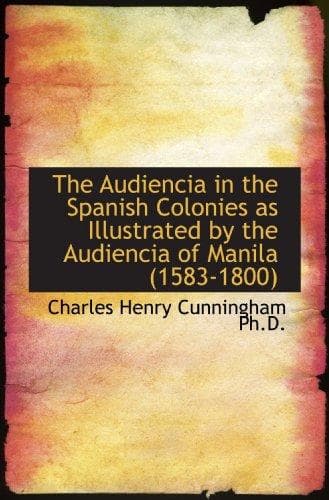
The Audiencia in the Spanish Colonies: As illustrated by the Audiencia of Manila (1583-1800)Cunningham, Charles Henry
History
The Audiencia in the Spanish Colonies: As illustrated by the Audiencia of Manila (1583-1800)
Cunningham, Charles Henry
Philippines -- History -- 1521-1812; Spain -- Colonies -- Administration
We may gather from these various citations taken from the early
history of the audiencias of South America that these tribunals not
only exercised the authority of governing ad interim, but that they
had permanent governmental and administrative powers as well. It
would seem, as Professor Moses has suggested, that the original
purpose of the Spanish government had been to entrust the executive
and administrative functions in the dependencies to the audiencia, and
that the endowment of the viceroys and captains-general with extensive
executive powers was an expedient to which Spain was obliged to turn
after the breakdown of the audiencia as an administrative agency. The
main fact to be emphasized in this connection is that during the
period of the promulgation of the laws which we are now studying,
the minor audiencias were exercising regular governmental powers.
The Audiencia of Mexico, which was created in 1527 to check the
excesses of Hernán Cortés, had participated in governmental affairs
even before the events described above. This tribunal, which was
composed of four magistrates, with the notorious Guzmán as president,
conducted the residencias of Cortés and his followers, and after
obtaining control of the government, administered affairs to suit
its own convenience. [587] It was at this time, and as a result of
these abuses, Bancroft tells us, that the Spanish government decided
to establish a viceroyalty in New Spain, with a semiregal court and
regal pretensions. A new tribunal was left in charge of governmental
affairs while this reform was being inaugurated. This second audiencia
governed with great satisfaction, correcting the abuses of its
predecessor and devoting itself to various improvements. [588]
Although the audiencia of 1528-1535 exercised the administrative
functions above mentioned, Bancroft brings forth no evidence in
support of the theory that it was ever the royal intention to entrust
the institution of the audiencia permanently with administrative
authority. He states that as early as 1530, three years after the
establishment of the first tribunal in Mexico, the sovereigns had
already decided to establish a viceroyalty. Although the audiencia
was entrusted with the government for a few years, the above facts
would seem to indicate that this was only a temporary arrangement. The
audiencia's chief attributes were judicial, and we have repeatedly
noted that the principal object of its establishment, aside from
the administration of justice, was to check the abuses of the
captain-general.
Public-domain text, read in full here on John Shaqi.
Reviews
Reviews
No reviews yet
Be the first to share your thoughts on this work.
Elsewhere in the archive
Join the Discussion
Join the discussion
Sign in to leave a comment or review.
Sign InorCreate an account