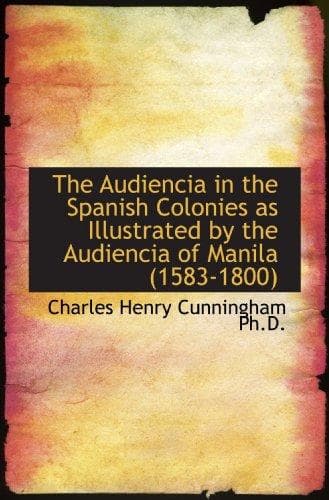
The Audiencia in the Spanish Colonies: As illustrated by the Audiencia of Manila (1583-1800)Cunningham, Charles Henry
History
The Audiencia in the Spanish Colonies: As illustrated by the Audiencia of Manila (1583-1800)
Cunningham, Charles Henry
Philippines -- History -- 1521-1812; Spain -- Colonies -- Administration
A complete understanding of the governmental functions and authority of
the audiencia, and the relation of the latter to the other departments
of government under these conditions may best be obtained by a review
of the circumstances and conditions of the audiencia's rule during
vacancies in the Philippines. The first occasion which in any way
approached the temporary rule of an audiencia in the Philippines was
in 1593, after the murder of Governor Gómez Pérez Dasmariñas. Pedro
de Rojas, who had been a magistrate of the audiencia when it was
suppressed in 1589, was at that time sole judge, with the additional
rank of lieutenant-governor and asesor, standing next to the governor
in authority. [605] After the death of Gómez Pérez Dasmariñas,
Rojas had occupied the governor's chair less than a year when he was
succeeded by the deceased governor's son, Luís Pérez Dasmariñas,
who became governor on the authority of a royal order found among
the papers of his father, whereby he was given the power to name
his successor. [606] His tenure seems to have been only temporary,
however, for as soon as news reached the court of the death of the
elder Dasmariñas, Francisco Tello de Guzmán was appointed permanent
governor and an audiencia was sent to the Islands, arriving at Manila
in 1596. [607] Meanwhile Rojas was succeeded as lieutenant-governor and
asesor by Antonio de Morga. According to Montero y Vidal, Dasmariñas
turned over the government to Morga in 1595, but it is more probable
that Morga assumed the temporary governorship when Dasmariñas was
in Cambodia and elsewhere fighting against the Dutch. In fact,
this conclusion is confirmed by Zúñiga. [608] At any rate, Morga
administered both governmental and military affairs on several
occasions when the various governors were absent from the Islands,
engaged in expeditions of conquest.
On the suppression of the audiencia in 1589, the administration of
justice remained entirely in the hands of the lieutenant-governor
and asesor. This position was first occupied by Rojas, and later by
Morga, who succeeded to the same judicial duties and enjoyed the same
prerogatives as had formerly belonged to the audiencia. In the absence
of the tribunal, therefore, they assumed functions which elsewhere
were carried out by the audiencia on the death of the governor or
viceroy, partly because they had taken the place of the audiencia, and
partly because they were lieutenants-governor. After the audiencia was
re-established in 1598, Morga continued in charge of military affairs
when the governor was absent or dead, while the audiencia administered
the government, not by virtue of any laws relating especially to the
Philippines, but seemingly because this was the general practice in
all of Spain's colonies. Morga's defense of Manila against the Dutch
in 1600 has been referred to in an earlier chapter.
Public-domain text, read in full here on John Shaqi.
Reviews
Reviews
No reviews yet
Be the first to share your thoughts on this work.
Elsewhere in the archive
Join the Discussion
Join the discussion
Sign in to leave a comment or review.
Sign InorCreate an account