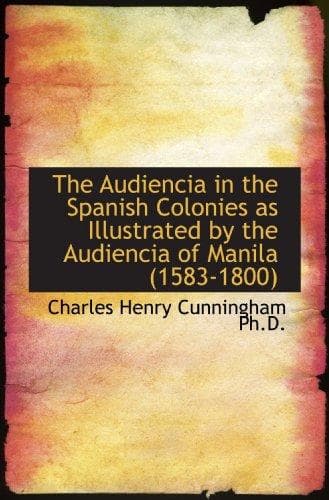
The Audiencia in the Spanish Colonies: As illustrated by the Audiencia of Manila (1583-1800)Cunningham, Charles Henry
History
The Audiencia in the Spanish Colonies: As illustrated by the Audiencia of Manila (1583-1800)
Cunningham, Charles Henry
Philippines -- History -- 1521-1812; Spain -- Colonies -- Administration
The creation of an audiencia, with judicial and advisory functions,
put an end to the exercise of these extraordinary powers by the
church and tended to confine its activities to the ecclesiastical
field. Nevertheless, the prelates continued to advise the governors
in administrative matters throughout the entire history of the
Islands. Their influence was especially strong in matters relating
to the natives, their government and protection, and the archbishops
even went so far at times as to give advice on questions of foreign
policy. Most of the time this counsel was solicited and was well
received. From 1650 onwards, as we noted in the last chapter, the
church waxed exceedingly strong in the Philippines and the prelates not
only advised, but dominated governors and audiencias. In 1668, Governor
Diego Salcedo was unseated, imprisoned and exiled by the commissary
of the Inquisition, while a pliant magistrate of the audiencia took
over the government and administered affairs in a manner entirely
satisfactory to his ecclesiastical supporters. The period from 1684 to
1690 showed the weakness of the audiencia when opposed by a powerful
prelate allied to a hostile governor. And in 1719 the church reached
the climax of its power by bringing about the murder of a governor,
and then succeeding him, overcoming every opposing element in the
colony, including the audiencia. From that time onward the prelates
governed during vacancies in the governorship--something which the
audiencia had failed to do. Finally, in 1762, Simón de Anda y Salazar
assumed the reigns of government and the obligations of defense,
an act which was sanctioned technically because he was an oidor but
really because he was an able man, capable of accomplishing what the
church had failed to do.
In this chapter it is not our purpose to review the historical facts of
the relations of the audiencia and the church or the growth of clerical
influence over the audiencia. These matters have been referred to in
earlier chapters. It is rather the design to study here the influence
which the audiencia, in its turn, exercised in ecclesiastical affairs,
noting whence it derived its authority and what was the nature of
its powers.
Public-domain text, read in full here on John Shaqi.
Reviews
Reviews
No reviews yet
Be the first to share your thoughts on this work.
Elsewhere in the archive
Join the Discussion
Join the discussion
Sign in to leave a comment or review.
Sign InorCreate an account