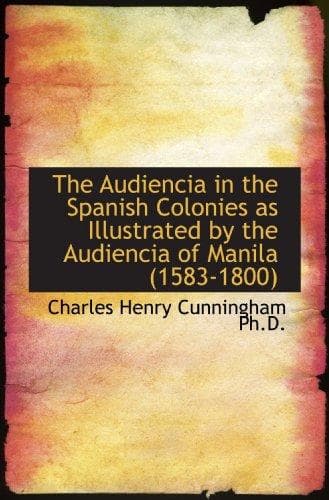
The Audiencia in the Spanish Colonies: As illustrated by the Audiencia of Manila (1583-1800)Cunningham, Charles Henry
History
The Audiencia in the Spanish Colonies: As illustrated by the Audiencia of Manila (1583-1800)
Cunningham, Charles Henry
Philippines -- History -- 1521-1812; Spain -- Colonies -- Administration
private judge, who, with the concurrence of the oficiales reales,
should have jurisdiction over and should proceed against, receive
and collect all the products and rents of the vacant archbishoprics
and bishoprics until the day on which the new prelates should
take possession of their offices, proceeding with full cognizance
... to the collection ... of whatever might be due, ... with the
assistance of the oficiales reales who in this matter are subject
to the royal audiencia. [790]
By this same law the audiencias, viceroys, presidents and tribunals
were forbidden to interfere with this judge in the execution of
his duties, or to impede the execution or the law in any manner
whatsoever. The estates of prelates were thus placed on a basis similar
to that occupied by the properties of civilians, which, we have noted,
were administered by a special magistrate of the audiencia. This cédula
also provided that all money left as a residue, after the debts of
the prelates were paid, should be sent to the king for distribution.
In view of the above-mentioned law, the practice followed in 1715,
on the death of Bishop Gorospe of Nueva Segovia, seems to have been a
direct violation of the royal command, and somewhat different from the
usual method of settling the estates of prelates. As soon as Gorospe
died at Magaldán, Pangasinán, the alcalde mayor of the province sent
immediate notification to the governor and audiencia. The tribunal,
in acuerdo, on the motion of the fiscal, authorized the alcalde mayor
and the treasury officials to take the espolio of that prelate, which
order was duly complied with. [791] The audiencia also dispatched a
formal notification to Archbishop de la Cuesta and the metropolitan
chapter, designating the former as the ecclesiastical governor of
the bishopric. [792]
The significant feature of this espolio is that it was taken by an
official as inferior in rank as an alcalde mayor through the express
authorization of the audiencia, instead of being conducted by the
second magistrate of the audiencia as the law directed. It is possible
that the arrival of the cédula of June 24, 1712, had been delayed, or
that this may have been a case, so frequent in the Spanish colonies,
of compliance without obedience. Certain it is that the conditions
of life and travel in the provinces were of such a character that an
oidor would have found it more comfortable to remain in the capital
and delegate the disagreeable duties of the espolio in a far-distant
province to the resident alcalde mayor. Attention has already been
called to various complaints made by governors and others against the
disinclination of the magistrates to submit to the inconveniences of
provincial inspections. Again, it is very probable that the time and
attention of the magistrate whose duty it should have been to take
this espolio were occupied with more important judicial duties. [793]
Public-domain text, read in full here on John Shaqi.
Reviews
Reviews
No reviews yet
Be the first to share your thoughts on this work.
Elsewhere in the archive
Join the Discussion
Join the discussion
Sign in to leave a comment or review.
Sign InorCreate an account