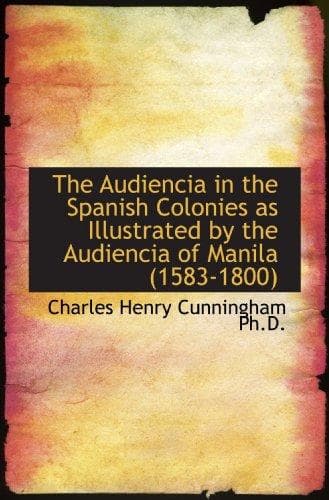
The Audiencia in the Spanish Colonies: As illustrated by the Audiencia of Manila (1583-1800)Cunningham, Charles Henry
History
The Audiencia in the Spanish Colonies: As illustrated by the Audiencia of Manila (1583-1800)
Cunningham, Charles Henry
Philippines -- History -- 1521-1812; Spain -- Colonies -- Administration
It has been shown in the preceding chapter that before the coming of
the audiencia, the church had utilized the weapon of excommunication
on very slight pretext, and it had been partly for the purpose of
restraining this abuse that the audiencia was established. [842] The
early governors, especially, had many difficulties with this phase of
ecclesiastical high-handedness and the letters of such executives as
De Vera, Tello, Dasmariñas, and Morga complained continually against
this particular abuse of power by the prelates, [843] regretting
the lack of any authority to set aside these excessive acts on the
part of the churchmen. All the above-mentioned governors had been
excommunicated for various acts in opposition to the ecclesiastical
power. Governor Ronquillo, in the characteristic letter which is
quoted in another part of this treatise, reported that the audiencia,
after its establishment, had effectively restrained the excesses
of excommunication on the part of the church. [844] Indeed, during
the twenty-five years succeeding Ronquillo's term as governor, the
audiencia had so frequently set aside ecclesiastical censures, and
so completely terminated the abuses of the privilege of sanctuary by
friars and priests, in fact so generally held at naught the principle
of ecclesiastical immunity, that the king, on November 13, 1626, was
obliged to issue a special cédula in restraint of his Manila tribunal
and for the protection of the ecclesiastical jurisdictions. [845]
Examination of a large number of cases shows that the method by which
the audiencia set aside excommunication was usually through an ultimate
reliance on force. Nevertheless, taking three hundred years of the
history of the Philippines into consideration, there were relatively
few cases in which matters went so far that the audiencia actually had
to use force, the case being usually that the judicial protest of the
tribunal against an abuse of this kind was sufficient. Theoretically,
any act of excommunication or interdict was suspended, ipso facto,
by the intervention of the audiencia pending further investigation,
and the prelate was required to abide by the decision of the tribunal.
Public-domain text, read in full here on John Shaqi.
Reviews
Reviews
No reviews yet
Be the first to share your thoughts on this work.
Elsewhere in the archive
Join the Discussion
Join the discussion
Sign in to leave a comment or review.
Sign InorCreate an account