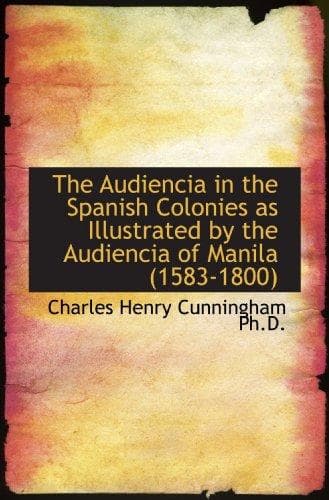
The Audiencia in the Spanish Colonies: As illustrated by the Audiencia of Manila (1583-1800)Cunningham, Charles Henry
History
The Audiencia in the Spanish Colonies: As illustrated by the Audiencia of Manila (1583-1800)
Cunningham, Charles Henry
Philippines -- History -- 1521-1812; Spain -- Colonies -- Administration
That the audiencia did not always try cases relating to the Indians
with requisite promptness, is evidenced by the many and repeated
letters of the king to the tribunal, to the fiscal, as protector of the
Indians, and to the regent, chiding these officials for delay. On many
occasions the royal zeal for justice in the treatment of the Indians,
based on a lack of knowledge of the true nature of the Filipino,
completely overruled all considerations of practicability and common
sense. As an illustration of this, on June 20, 1686, certain natives
of the province of Bulacán sent false evidence to the Council of the
Indies; this testimony was taken in preference to that remitted by
the audiencia, the decision of the latter body being reversed by the
Council of the Indies. The audiencia refused to allow the execution of
the new judgment; the oidores all offered to resign in protest, and
the regent, at the risk of removal, reopened the case. It was proved
by the testimony of a number of officials and by the confessions of
the natives who had perjured themselves that the evidence upon which
the Council had acted was false. [169] A record of these proceedings
was remitted to the Council and that tribunal promptly reversed its
former decision.
Further illustrations of the authority of the audiencia in cases
involving natives may be seen in suits which arose from time to
time over the illegal treatment of the latter by the friars and the
unjust occupation of the natives' lands by the religious orders. These
suits afford illustration, also, of the services of the audiencia as
an agency to force persons to show their titles to lands which they
held. [170] This jurisdiction will be given more detailed treatment
in the proper place, but the brief citation of one or two cases among
many seems advisable to illustrate the activity of the audiencia in
protecting the Indians, both by trying suits involving them and by
actually intervening in their behalf.
Various revolts broke out among the Indians near Manila from 1740
to 1750. These insurrections were said to have been provoked by the
encroachments of the Augustinians and Dominicans on the lands of the
natives. The matter was called to the attention of the home government,
and Pedro Calderón Enríquez, an oidor, was ordered to investigate
the charges made against these religious orders and to ascertain
the validity of their claims to the lands in question. The friars,
when ordered to submit titles to a secular judge, refused to comply,
claiming ecclesiastical exemption. In the face of their opposition,
Calderón dispossessed the friars of the lands which they were said to
have usurped and which they were continuing to hold without legitimate
title, restoring the lands to the crown. The case was appealed to
the audiencia and that tribunal upheld the visitor.
Public-domain text, read in full here on John Shaqi.
Reviews
Reviews
No reviews yet
Be the first to share your thoughts on this work.
Elsewhere in the archive
Join the Discussion
Join the discussion
Sign in to leave a comment or review.
Sign InorCreate an account