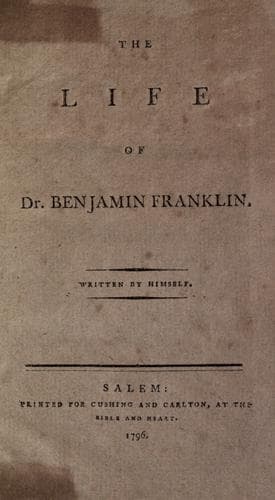
The Autobiography of Benjamin FranklinFranklin, Benjamin
ReligionComparative
The Autobiography of Benjamin Franklin
Franklin, Benjamin
Franklin, Benjamin, 1706-1790; Statesmen -- United States -- Biography
These embarrassments that the Quakers suffer'd from having establish'd
and published it as one of their principles that no kind of war was
lawful, and which, being once published, they could not afterwards,
however they might change their minds, easily get rid of, reminds me of
what I think a more prudent conduct in another sect among us, that of
the Dunkers. I was acquainted with one of its founders, Michael
Welfare, soon after it appear'd. He complain'd to me that they were
grievously calumniated by the zealots of other persuasions, and charg'd
with abominable principles and practices, to which they were utter
strangers. I told him this had always been the case with new sects,
and that, to put a stop to such abuse, I imagin'd it might be well to
publish the articles of their belief, and the rules of their
discipline. He said that it had been propos'd among them, but not
agreed to, for this reason: "When we were first drawn together as a
society," says he, "it had pleased God to enlighten our minds so far as
to see that some doctrines, which we once esteemed truths, were errors;
and that others, which we had esteemed errors, were real truths. From
time to time He has been pleased to afford us farther light, and our
principles have been improving, and our errors diminishing. Now we are
not sure that we are arrived at the end of this progression, and at the
perfection of spiritual or theological knowledge; and we fear that, if
we should once print our confession of faith, we should feel ourselves
as if bound and confin'd by it, and perhaps be unwilling to receive
farther improvement, and our successors still more so, as conceiving
what we their elders and founders had done, to be something sacred,
never to be departed from."
This modesty in a sect is perhaps a singular instance in the history of
mankind, every other sect supposing itself in possession of all truth,
and that those who differ are so far in the wrong; like a man traveling
in foggy weather, those at some distance before him on the road he sees
wrapped up in the fog, as well as those behind him, and also the people
in the fields on each side, but near him all appears clear, tho' in
truth he is as much in the fog as any of them. To avoid this kind of
embarrassment, the Quakers have of late years been gradually declining
the public service in the Assembly and in the magistracy, choosing
rather to quit their power than their principle.
Public-domain text, read in full here on John Shaqi.
Reviews
Reviews
No reviews yet
Be the first to share your thoughts on this work.
Elsewhere in the archive
Join the Discussion
Join the discussion
Sign in to leave a comment or review.
Sign InorCreate an account