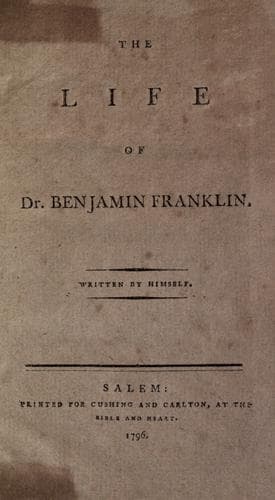
The Autobiography of Benjamin FranklinFranklin, Benjamin
ReligionComparative
The Autobiography of Benjamin Franklin
Franklin, Benjamin
Franklin, Benjamin, 1706-1790; Statesmen -- United States -- Biography
He smil'd at my ignorance, and reply'd, "These savages may, indeed, be
a formidable enemy to your raw American militia, but upon the king's
regular and disciplin'd troops, sir, it is impossible they should make
any impression." I was conscious of an impropriety in my disputing
with a military man in matters of his profession, and said no more.
The enemy, however, did not take the advantage of his army which I
apprehended its long line of march expos'd it to, but let it advance
without interruption till within nine miles of the place; and then,
when more in a body (for it had just passed a river, where the front
had halted till all were come over), and in a more open part of the
woods than any it had pass'd, attack'd its advanced guard by a heavy
fire from behind trees and bushes, which was the first intelligence the
general had of an enemy's being near him. This guard being disordered,
the general hurried the troops up to their assistance, which was done
in great confusion, thro' waggons, baggage, and cattle; and presently
the fire came upon their flank: the officers, being on horseback, were
more easily distinguish'd, pick'd out as marks, and fell very fast; and
the soldiers were crowded together in a huddle, having or hearing no
orders, and standing to be shot at till two-thirds of them were killed;
and then, being seiz'd with a panick, the whole fled with precipitation.
The waggoners took each a horse out of his team and scamper'd; their
example was immediately followed by others; so that all the waggons,
provisions, artillery, and stores were left to the enemy. The general,
being wounded, was brought off with difficulty; his secretary, Mr.
Shirley, was killed by his side; and out of eighty-six officers,
sixty-three were killed or wounded, and seven hundred and fourteen men
killed out of eleven hundred. These eleven hundred had been picked men
from the whole army; the rest had been left behind with Colonel Dunbar,
who was to follow with the heavier part of the stores, provisions, and
baggage. The flyers, not being pursu'd, arriv'd at Dunbar's camp, and
the panick they brought with them instantly seiz'd him and all his
people; and, tho' he had now above one thousand men, and the enemy who
had beaten Braddock did not at most exceed four hundred Indians and
French together, instead of proceeding, and endeavoring to recover some
of the lost honour, he ordered all the stores, ammunition, etc., to be
destroy'd, that he might have more horses to assist his flight towards
the settlements, and less lumber to remove. He was there met with
requests from the governors of Virginia, Maryland, and Pennsylvania,
that he would post his troops on the frontiers, so as to afford some
protection to the inhabitants; but he continu'd his hasty march thro'
all the country, not thinking himself safe till he arriv'd at
Philadelphia, where the inhabitants could protect him. This whole
transaction gave us Americans the first suspicion that our exalted
Public-domain text, read in full here on John Shaqi.
Reviews
Reviews
No reviews yet
Be the first to share your thoughts on this work.
Elsewhere in the archive
Join the Discussion
Join the discussion
Sign in to leave a comment or review.
Sign InorCreate an account