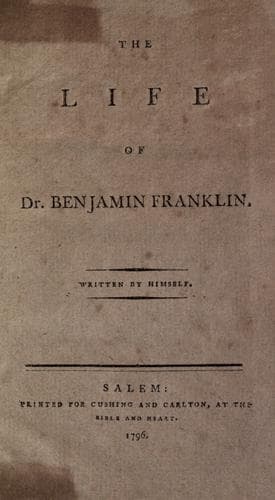
The Autobiography of Benjamin FranklinFranklin, Benjamin
ReligionComparative
The Autobiography of Benjamin Franklin
Franklin, Benjamin
Franklin, Benjamin, 1706-1790; Statesmen -- United States -- Biography
Governor Morris, who had continually worried the Assembly with message
after message before the defeat of Braddock, to beat them into the
making of acts to raise money for the defense of the province, without
taxing, among others, the proprietary estates, and had rejected all
their bills for not having such an exempting clause, now redoubled his
attacks with more hope of success, the danger and necessity being
greater. The Assembly, however, continu'd firm, believing they had
justice on their side, and that it would be giving up an essential
right if they suffered the governor to amend their money-bills. In one
of the last, indeed, which was for granting fifty thousand pounds, his
propos'd amendment was only of a single word. The bill expressed "that
all estates, real and personal, were to be taxed, those of the
proprietaries not excepted." His amendment was, for not read only: a
small, but very material alteration. However, when the news of this
disaster reached England, our friends there, whom we had taken care to
furnish with all the Assembly's answers to the governor's messages,
rais'd a clamor against the proprietaries for their meanness and
injustice in giving their governor such instructions; some going so far
as to say that, by obstructing the defense of their province, they
forfeited their right to it. They were intimidated by this, and sent
orders to their receiver-general to add five thousand pounds of their
money to whatever sum might be given by the Assembly for such purpose.
This, being notified to the House, was accepted in lieu of their share
of a general tax, and a new bill was form'd, with an exempting clause,
which passed accordingly. By this act I was appointed one of the
commissioners for disposing of the money, sixty thousand pounds. I had
been active in modelling the bill and procuring its passage, and had,
at the same time, drawn a bill for establishing and disciplining of a
voluntary militia, which I carried thro' the House without much
difficulty, as care was taken in it to leave the Quakers at their
liberty. To promote the association necessary to form the militia, I
wrote a dialogue,[14] stating and answering all the objections I could
think of to such a militia, which was printed, and had, as I thought,
great effect.
[14] This dialogue and the militia act are in the
"Gentleman's Magazine" for February and March, 1756.
—[Marg. note.]
Public-domain text, read in full here on John Shaqi.
Reviews
Reviews
No reviews yet
Be the first to share your thoughts on this work.
Elsewhere in the archive
Join the Discussion
Join the discussion
Sign in to leave a comment or review.
Sign InorCreate an account