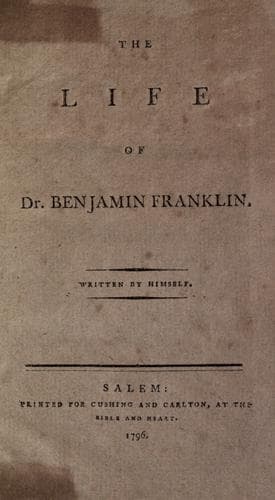
The Autobiography of Benjamin FranklinFranklin, Benjamin
ReligionComparative
The Autobiography of Benjamin Franklin
Franklin, Benjamin
Franklin, Benjamin, 1706-1790; Statesmen -- United States -- Biography
1729 Becomes proprietor and editor of the "Pennsylvania Gazette";
prints, anonymously, "Nature and Necessity of a Paper Currency";
opens a stationer's shop.
1730 Marries Rebecca Read.
1731 Founds the Philadelphia Library.
1732 Publishes the first number of "Poor Richard's Almanac" under
the pseudonym of "Richard Saunders." The Almanac, which
continued for twenty-five years to contain his witty,
worldly-wise sayings, played a very large part in bringing
together and molding the American character which was at
that time made up of so many diverse and scattered types.
1733 Begins to study French, Italian, Spanish, and Latin.
1736 Chosen clerk of the General Assembly; forms the Union Fire
Company of Philadelphia.
1737 Elected to the Assembly; appointed Deputy Postmaster-General;
plans a city police.
1742 Invents the open, or "Franklin," stove.
1743 Proposes a plan for an Academy, which is adopted 1749 and
develops into the University of Pennsylvania.
1744 Establishes the American Philosophical Society.
1746 Publishes a pamphlet, "Plain Truth," on the necessity for
disciplined defense, and forms a military company; begins
electrical experiments.
1748 Sells out his printing business; is appointed on the
Commission of the Peace, chosen to the Common Council,
and to the Assembly.
1749 Appointed a Commissioner to trade with the Indians.
1751 Aids in founding a hospital.
1752 Experiments with a kite and discovers that lightning is an
electrical discharge.
1753 Awarded the Copley medal for this discovery, and elected a
member of the Royal Society; receives the degree of M.A.
from Yale and Harvard. Appointed joint Postmaster-General.
1754 Appointed one of the Commissioners from Pennsylvania to the
Colonial Congress at Albany; proposes a plan for the union
of the colonies.
1755 Pledges his personal property in order that supplies may be
raised for Braddock's army; obtains a grant from the Assembly
in aid of the Crown Point expedition; carries through a bill
establishing a voluntary militia; is appointed Colonel,
and takes the field.
1757 Introduces a bill in the Assembly for paving the streets of
Philadelphia; publishes his famous "Way to Wealth"; goes to
England to plead the cause of the Assembly against the
Proprietaries; remains as agent for Pennsylvania; enjoys the
friendship of the scientific and literary men of the kingdom.
[HERE THE AUTOBIOGRAPHY BREAKS OFF]
1760 Secures from the Privy Council, by a compromise, a decision
obliging the Proprietary estates to contribute to the public
revenue.
Public-domain text, read in full here on John Shaqi.
Reviews
Reviews
No reviews yet
Be the first to share your thoughts on this work.
Elsewhere in the archive
Join the Discussion
Join the discussion
Sign in to leave a comment or review.
Sign InorCreate an account