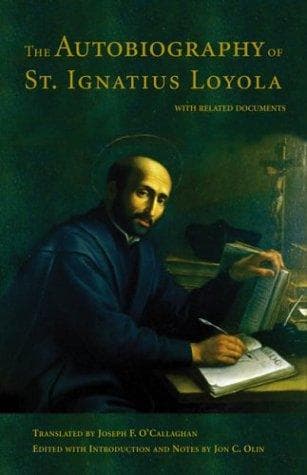
The Autobiography of St. IgnatiusIgnatius, of Loyola, Saint
Religion
The Autobiography of St. Ignatius
Ignatius, of Loyola, Saint
Christian saints -- Spain -- Biography; Ignatius, of Loyola, Saint, 1491-1556
This was at the end of the eighteenth century. In our own time in one
classroom Father Cardella counted seventeen different orders of all
different nationalities present at the lectures of theology in the
Roman College.
* * * * *
The Roman College was the type of the Jesuit College. It was begun by
Francis Borgia, in 1551, at the foot of the Capitol in Rome, with
fourteen members of the Order and Father John Peltier, a Frenchman, as
Superior.
The professors taught rhetoric and three languages,--Hebrew, Greek,
and Latin. There were present there at a given time 2107 students, 300
in theology. The most eminent professors filled the chairs:
theologians like Suarez and Vasquez; commentators such as Cornelius a
Lapide and Maldonatus; founders of national history schools, as
Mariana and Pallavicini; Clavius, reformer of the Gregorian Calendar;
Kircher, universal in the exact sciences, while the other colleges
throughout the world remained provided with their own required forces
and maintained their own prestige.
* * * * *
From this college came forth distinguished men in every line of
intellectual life, and general eminence, men of elevated thought and
of noble and generous minds. In particular three characters
came--young men that were to fill with admiration of their greatness
the succeeding century.
Stanislaus Kostka, a Polish noble who died at seventeen years of age;
Aloysius Gonzaga, an Italian prince of twenty-three; and John
Berchmans, a Flemish townsman of twenty-two.
Among some of the famous men educated by the Jesuits we find Bossuet,
Corneille, Moliere, Tasso, Fontenelle, Diderot, Voltaire, and
Bourdaloue, himself a Jesuit.
* * * * *
When Pere Poree replied to the remark that he was not one of the great
poets, he said, "At least you may grant that I have been able to make
some of them." A few others were Descartes, Buffon, Justus Lipsius,
Muratori the historian, Calderon, and Vico, the author of "Ideas of
History," Richelieu, Tilly, Malesherbes, Don John of Austria,
Luxembourg, Esterhazy, Choiseul, St. Francis de Sales, Lambertini,
afterward Benedict XIV, the most learned of the popes, and the present
Pontiff, Pope Leo XIII, renowned for his learning and wisdom.
Nearly all the Jesuit writers had been Jesuit professors, with almost
no exception, and nearly all had taught humanities, belles-lettres,
and rhetoric. Father Southwell in 1676 numbers 2240 authors, and
Father de Backer in 1876 counts 11,100.
AUTHORS
We find some remarkable authors among the Jesuit writers. Foremost
come the Bollandists, renowned throughout the world for their
monumental work, the "Acta Sanctorum." Similar gigantic works were
carried on by Fathers de Backer, Sommervogel, and Pachtler. In the
various branches of learning we need mention a few of the greater
writers.
In astronomy, we find Ricci, Perry, De Vico, Secchi, Curley, Sestini.
Public-domain text, read in full here on John Shaqi.
Reviews
Reviews
No reviews yet
Be the first to share your thoughts on this work.
Elsewhere in the archive
Join the Discussion
Join the discussion
Sign in to leave a comment or review.
Sign InorCreate an account