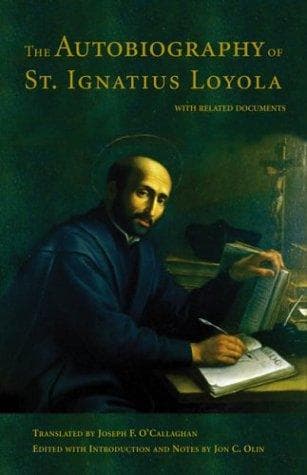
The Autobiography of St. IgnatiusIgnatius, of Loyola, Saint
Religion
The Autobiography of St. Ignatius
Ignatius, of Loyola, Saint
Christian saints -- Spain -- Biography; Ignatius, of Loyola, Saint, 1491-1556
In mathematics, Hagen, Algue.
In naval tactics, "The Jesuit's Book."
In archaeology, Garucci, Marchi, the master of De Rossi.
In Oriental languages, Strassmaier, Harvas, Maas, Van den Gheyn.
In theology, Suarez, Vasquez, Toletus, Maldonatus, Franzelin.
In philosophy, Cominbricenses, Liberatore.
In moral philosophy, Busenbaum, Gury, Toledo, Ballerini, Layman,
Lehmkuhl, Genicot.
In asceticism, Alvarez de Paz, Gaudier, Rodriguez, Scaramelli, Grou.
The Spiritual Exercises comprise a whole library. Father Watragan has
written a work merely to record the editions and commentaries on these
Exercises.
THE EDUCATIONAL PLAN OF ST. IGNATIUS
St. Ignatius had gathered about him a body of picked men. The Roman
College, the type of colleges of Jesuit education, would have for its
professors only those who had been doctors of the University of
Paris.
The outline of the course of education was given by St. Ignatius. It
was completed and developed by Aquaviva. The work was still more
perfected by Father Laynez, of whom it is said,--
"St. Ignatius praised him not only on account of other great merits,
but particularly for devising and arranging the system of colleges."
As to the number of students found under a unified method of thorough
teaching, it will be interesting to take them in review.
In Rome in 1584, the twenty colleges attending classes in the Roman
College numbered 2108 students, in Poland there were 10,000 young men
chiefly of the nobility, at Rome 2000, at La Fleche 1700. In the
seventeenth century at the College of Louis le Grand, in Paris, the
number varied between 2000 and 3000. In 1627 the Province of Paris had
in fourteen colleges 13,195 students.
The papal seminaries under Gregory XIII, at Vienna, Dillengen, Fulda,
Prague, Graetz, Olmuetz, Wilna, as well as in Japan, were directed by
the Fathers, as also that of Pius V and of St. Charles Borromeo at
Milan.
Taking an average, there were more than two hundred thousand students
being educated in these educational institutions.
A comparison could be made on this basis of the work done by the Order
and that which is accomplished by Oxford.
If Oxford spends annually a revenue of $2,500,000 to supply facilities
for higher education to two thousand of the nobility and gentry, how
much would be required to educate a quarter of a million
students,--not two thousand, but two hundred and fifty thousand?
The fundamental principles in the educational institute of St.
Ignatius were these:--
First, solidity and thoroughness.
The first condition of all higher studies as well as of lower studies
was such that, as St. Ignatius said, "It was useless to begin at the
top, as the edifice without a good foundation would never stand."
Let literature and philosophy be gone through with satisfactorily, and
then theology may be approached.
Public-domain text, read in full here on John Shaqi.
Reviews
Reviews
No reviews yet
Be the first to share your thoughts on this work.
Elsewhere in the archive
Join the Discussion
Join the discussion
Sign in to leave a comment or review.
Sign InorCreate an account