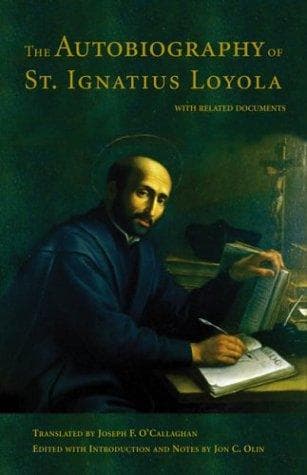
The Autobiography of St. IgnatiusIgnatius, of Loyola, Saint
Religion
The Autobiography of St. Ignatius
Ignatius, of Loyola, Saint
Christian saints -- Spain -- Biography; Ignatius, of Loyola, Saint, 1491-1556
Literature must come first of all. St. Ignatius provides for law and
medicine, but by professors of law and medicine outside of the Order;
but no professors of the Order were sent for work outside of Jesuit
institutions. If the younger men were sent abroad, the younger
generation would be deprived of that type; and if eminent men were
sent forth without a permanent Jesuit College, the work would not be
that of the Order, but of scattered individuals, and would soon
perish.
In the cause of education St. Ignatius had placed in his charter the
watchwords "Defence and Advance." As a leader of a military type he
had gathered about him the flower of youth and of mature age, from
college and university, from doctor's chair and prince's throne, and
in fifteen years from the foundation of the Order left one hundred
colleges and houses in Portugal, Spain, Italy, Sicily, Germany,
France, Brazil, and the East Indies. Xavier traveled from India and
Ceylon, in the west, to Malucca, Japan, and the coast of China on the
east. Wherever the energy and activity of Apostolic zeal penetrated it
was with the purpose, and usually the result, of permanent Apostolic
work in the foundation of educational institutions. Father de Backer
says,--
"Wherever a Jesuit set his foot, wherever there was founded a house, a
college, a mission, there too came apostles of another class, who
labored, who taught, who wrote."
This is true even to our day where in the Rocky Mountains, beside the
mission house of Spokane Falls, rises the Jesuit College of Spokane.
Sixty years later than the time of St. Ignatius there were 272
colleges, and in 150 years the collegiate and university houses of
education numbered 769.
"Looking at these seven hundred institutions of secondary and superior
education," says Father Thomas Hughes in his work on Loyola, "in their
scope of legislative executive power we find they were not so much a
plurality of institutions as a single one.
"If we look at the 92 colleges in France, although the University of
Paris was in one quarter of the city, and in that sense materially
one,--although including 50 colleges,--yet in the formal and essential
bond these 92 Jesuit colleges were vastly more of a unit as an
identical educational power than any faculty existing. No faculty at
Paris, Rome, Salamanca, or Oxford ever preserved the control over its
50, 20, or 8 colleges that each Provincial exercised over his 10, 20,
or 30 colleges, or the general of the Order over the 700 colleges,
with 22,126 members in the Order."
At the present day we find the Jesuit colleges in almost every part of
the known world. In Rome and in China, in South Africa and North
America, in the Philippine Islands as well as in Ceylon and Egypt, in
Australia and Cuba, as well as in Syria and the city of New York.
We may glance briefly at the colleges scattered over the world,
containing to-day 52,692 Jesuit pupils.
Public-domain text, read in full here on John Shaqi.
Reviews
Reviews
No reviews yet
Be the first to share your thoughts on this work.
Elsewhere in the archive
Join the Discussion
Join the discussion
Sign in to leave a comment or review.
Sign InorCreate an account