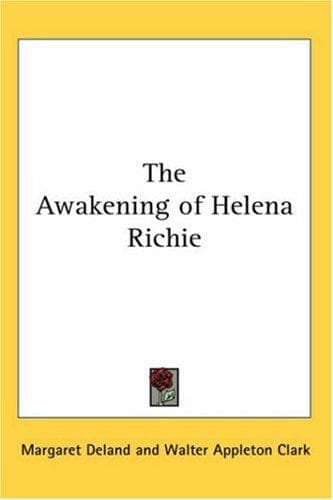
The Awakening of Helena RichieDeland, Margaret Wade Campbell
General
The Awakening of Helena Richie
Deland, Margaret Wade Campbell
Women -- Fiction
The solid ground of experience was heaving and staggering under her
feet, and in the midst of the elemental tumult, she had her first dim
glimpse of responsibility. It was a blasting glimpse, that sent her
cowering back to assertions of her right to her own happiness. Thirteen
years ago Lloyd had made those assertions, and she had accepted them
and built them into a shelter against the assailing consciousness that
she was an outlaw, pillaging respect and honor from her community.
Until now nothing had ever shaken that shelter. Nor had its dark walls
been pierced by the disturbing light of any heavenly vision declaring
that when personal happiness conflicts with any great human ideal, the
right to claim such happiness is as nothing compared to the privilege
of resigning it. She had not liked the secrecy which her shelter
involved, no refined temperament likes secrecy. But the breaking of the
law, in itself, had given her no particular concern; behind her
excusing platitudes she had always been comfortable enough. Even that
whirlwind of anger at Benjamin Wright's contempt had only roused her to
buttress her shelter with declarations that she was not harming
anybody. But sitting there between William King and his wife, in the
midst of decorously mournful Old Chester, she knew she could never say
that any more; not only because a foolish and ill-balanced youth had
been unable to survive a shattered ideal, but because she began
suddenly and with consternation to understand that the whole vast
fabric of society rested on that same ideal. And she had been secretly
undermining it! Her breath caught, strangling, in her throat. In the
crack of the pistol and the crash of ruined family life she heard for
the first time the dreadful sound of the argument of her life to other
lives; and at that sound the very foundation of those excuses of her
right to happiness, rocked and crumbled and left her selfishness naked
before her eyes.
It was so unbearable, that instantly she sought another shelter:
obedience to the letter of the Law--Marriage. To marry her fellow
outlaw seemed to promise both shelter and stability--for in her
confusion she mistook marriage for morality. At once! Never mind if he
were tired of her; never mind if she must humble what she called her
pride, and plead with him to keep his word; never mind anything--except
this dreadful revelation: that no one of us may do that which, if done
by all, would destroy society. Yes; because she had not understood
that, a boy had taken his own life.... Marriage! That was all she
thought of; then, suddenly, she cowered--the feet of the bearers again.
"I will be married," she said with dry lips, "oh, I will-I _will_!" And
Martha King, looking at her furtively, thought she prayed.
It was not a prayer, it was only a promise. For with the organic
upheaval into her soul of the primal fact of social responsibility, had
come the knowledge of guilt.
_But the Lord was not in the earthquake._
CHAPTER XXV
Public-domain text, read in full here on John Shaqi.
Reviews
Reviews
No reviews yet
Be the first to share your thoughts on this work.
Elsewhere in the archive
Join the Discussion
Join the discussion
Sign in to leave a comment or review.
Sign InorCreate an account