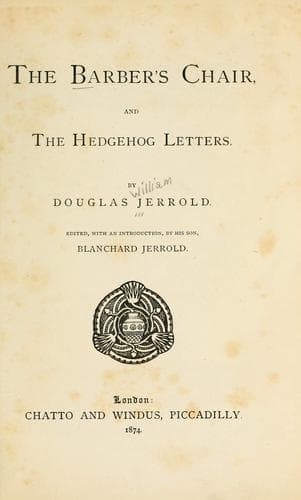
The barber's chair; and, The hedgehog lettersJerrold, Douglas William
General
The barber's chair; and, The hedgehog letters
Jerrold, Douglas William
English literature -- 19th century; English wit and humor
When Sir Robert said he should keep on the income-tax for three years
longer, almost the whole House fell into fits of delight at his
goodness. You might have seen Whig embracing Tory, Radical throwing
his arms about the neck of Conservative, and Young England with tears
of gratitude rolling like butter-milk down upon his white waistcoat.
When Sir Robert had quite finished his speech, there was a shower of
nosegays flung upon him from the Treasury benches, just in the same
way as now and then you pelt the actors at the playhouses! Sir Robert
picked ’em all up, and pressed ’em to his heart, and from the corners
of his mouth smiled the thousand thanks. Then sitting down, he very
handsomely gave a flower apiece to what he calls his colleagues. He
insisted--amidst the cheers of the House--on putting a forget-me-not
in the button-hole of Mr Gladstone (who sobbed audibly at the touch
of friendship); and then he handed a lily--as an emblem of the Home
Secretary’s reputation--to Sir James Graham. At this, I needn’t tell
you, there were “roars of laughter.” To be sure, at this season of the
year these flowers were artificial; but for which reason, it was said
by somebody, they were more in keeping with Sir Robert’s measures.
Two or three members--for form’s sake--abused the income-tax, but
nevertheless said they would vote for it. Lord John Russell called it a
shameful, infamous, ignominious, tyrannical, prying impost: he would,
however, support it. This is as if a man should denounce another as a
coward, a ruffian, and a thief, and then--fold him to his bosom! But
they do odd things in Parliament. Sir Robert says we are to have the
income-tax for only three years longer. Nonsense! He intends that we
should grow with it upon us. He’ll no more take it off than a Chinese
mother will take off the little shoe that, for the beauty of the
full-grown woman, she puts upon the foot of her baby girl. The child
may twist, and wriggle, and squall; and the mother may now and then say
pretty things--make pretty promises to it to keep it quiet--but the
shoe’s there for the sufferer’s life. Now John Bull--thinks Sir Robert
Peel--will move all the better with his foot in the income-tax: all the
better too, because it most galls and crushes a lower member. However,
we are to have the duty off glass; which, says Sir Robert, is much
better than if the duty were taken off light. It is not for such as me
to dispute with a minister, but I can’t see how, if I’m to get my house
glazed duty free, it’s quite as good as if there was no window-tax. To
be sure, if a man, as a householder, were to new glaze himself from
top to bottom once a quarter, it might be another thing; he might save
upon the glass what he now pays for the sun that, in London, tries to
come through it. He may certainly afford to have more windows, but
will, I say, the saving on the glass pay for the light? Besides, not
light alone, but air is paid for. There is at the present time a secret
Public-domain text, read in full here on John Shaqi.
Reviews
Reviews
No reviews yet
Be the first to share your thoughts on this work.
Elsewhere in the archive
Join the Discussion
Join the discussion
Sign in to leave a comment or review.
Sign InorCreate an account