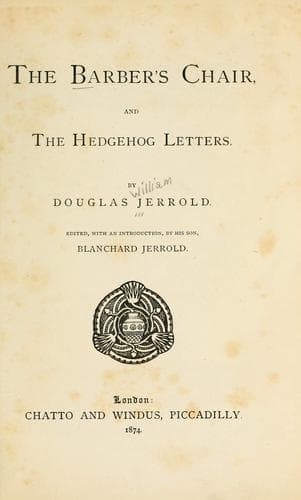
The barber's chair; and, The hedgehog lettersJerrold, Douglas William
General
The barber's chair; and, The hedgehog letters
Jerrold, Douglas William
English literature -- 19th century; English wit and humor
Upon this, the Speaker, in one of his conciliatory moods, observed that
“such observations were very personal. Would the honourable gentleman
withdraw them?” Whereupon Mr Duncombe answered: “Sir, I applied those
observations to the right honourable gentleman in his ministerial
capacity: to those observations and to those topics I adhere; so they
_must and shall remain_.”
And they _do_ remain. And Sir James remains “as a minister,” a “mean,”
“base,” cowardly agent! How strange is the distinction between the
minister and the man!--they’re quite two different things, like the
calipee and calipash of a turtle.
Sir James Graham rose to answer, with a confidence that would have
honoured the Old Bailey. He said, “Mr Duncombe was a person quite
indifferent to him.” This reminds me of the chap who, after he’d been
flogged half a mile and more at the cart’s tail, with all the world
looking on, said to the man that had flayed him, “Sir, you’re beneath
my notice.” I could write more, but Lumpy’s called me for a fare. The
fun, however, is not yet over; and you may hear more of Sir James in my
next. Meantime, if you write, don’t either use wax or wafers; it’s only
wasting property. Send your letters open, and believe me, your faithful
friend,
JUNIPER HEDGEHOG.
LETTER IX.--_To Mrs Hedgehog of New York._
DEAR GRANDMOTHER,--It was very kind of you, though away from Old
England, to have prayers put up for the Bishops of Exeter and London,
and Mr Courtenay and Mr Ward, with all the unfortunate young clergymen
who’ve been frightening their good Mother Church, for all the world
like young ducklings that, hatched by a hen, would take water. The
bishops, you will be glad to learn, are much better; and now, Sunday
after Sunday, the young parsons are taking off their white surplices
and putting on their old gowns, just like idle, flashy, young dogs,
who’ve been making a noise at a masquerade, but are once more prepared
to go back to their serious counters. Mr Courtenay and two or three of
his kidney did think of putting on chain-armour under their surplices,
like the Templars that you once saw in the play of Ivanhoe; but whether
the Bishop of Exeter has interfered or not, I can’t say: the thing’s
given up.
Mr Ward, who has been turned out of Oxford for his ideal of a Christian
Church--which means a Church with censers and candlesticks, and
pictures of the Virgin, and martyrs’ bones, and other properties--is
going to be married, if the business isn’t done already. I shouldn’t
have written upon the matter, only Mr W. has printed a letter in all
the papers, giving _his_ notions of the holy state. They certainly are
very sweet and complimentary to the lady chosen by Mr Ward, for he
says--
“First, I hold it most firmly as a truth even of _natural
religion_ that celibacy _is a higher condition of life_ than
marriage.”
Public-domain text, read in full here on John Shaqi.
Reviews
Reviews
No reviews yet
Be the first to share your thoughts on this work.
Elsewhere in the archive
Join the Discussion
Join the discussion
Sign in to leave a comment or review.
Sign InorCreate an account