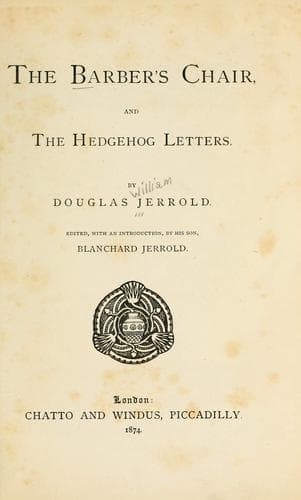
The barber's chair; and, The hedgehog lettersJerrold, Douglas William
General
The barber's chair; and, The hedgehog letters
Jerrold, Douglas William
English literature -- 19th century; English wit and humor
Well, I drove as near as I could to the place, and then I got a boy
to hold the horse, and got down and went along with my fare. If
it didn’t make me quite savage and sick, Sam, to see hundreds of
fellows--well-dressed gentry, mind you--gaping and lounging about, and
now poking the grass with their sticks, as if it was something precious
because blood had been shed upon it, and now breaking bits of the trees
about the place, I suppose to make toothpicks and cribbage-pegs of.
And then there were fathers--precious fools!--bringing their children
with them, boys and girls, as though they’d brought ’em to a stall of
gingerbread nuts, where they might fill their bellies and be happy!
But the worst of all, Sam, was to see the women. Lots of ’em nice,
young, fair creatures, tender as if they were made of best wax--there
they were running along and looking at the bushes and the grass, and
talking of the blood and the death-struggle, just as if they were
looking at and talking of the monkeys at the ’Logical Gardens. Well,
the handsomest of ’em after a time looked to me no better than young
witches--and that’s the truth. Every minute I expected some of ’em to
do a polka, they did after a time seem to enjoy themselves.
Well, all of a sudden I missed my fare. Looking about, I saw my
gentleman go up to the brick wall. Then he took a heavy hammer out
of his pocket, and knocking away, split a brick, and then knocked it
out of the wall. “This is something like,” said he to me, twinkling
his eye; “something to remember the murder by.” And then he carefully
wrapt the pieces of brick in a silk handkerchief, and put ’em in his
breast-pocket, as if they’d been lumps of diamonds. I said nothing--but
I could have kicked him. However, he hadn’t done yet, for going to a
part of the field, he said to his wife--for so she proved to be--“This
is the place, Arabella; the very place: where’s the pots?” Then the
lady took three garden-pots from a basket, and then her husband,
dropping upon his knees, turned up the earth with a large clasp-knife,
and when he’d filled the pots, he dug up two or three daisy roots,
and set ’em; his wife smiling and looking as happy all the while as
if she’d got a new gown, or a new bonnet, or both. “Come,” said the
gentleman, squinting at the daisy roots, and twisting one of the pots
in his hand, “this is what I call worth coming for. As I say, this
is something to recollect a murder by. Humph!” and then he paused a
bit, and looked very wishfully at the stile--“Humph! I should like
a walking-stick out of that; but the police are so particular, I
suppose they wouldn’t suffer it. Come along, Arabella;” and securing
the broken brick and the daisy roots in the pots, my gentleman went
back to the cab. “Now drive as fast as you can to the church,” he
said; “I wouldn’t but be there for any money.” Well, I never did drive
through such a crowd, but at last I managed it; and at last--but
no; I haven’t patience enough to write any more upon this part of
Public-domain text, read in full here on John Shaqi.
Reviews
Reviews
No reviews yet
Be the first to share your thoughts on this work.
Elsewhere in the archive
Join the Discussion
Join the discussion
Sign in to leave a comment or review.
Sign InorCreate an account