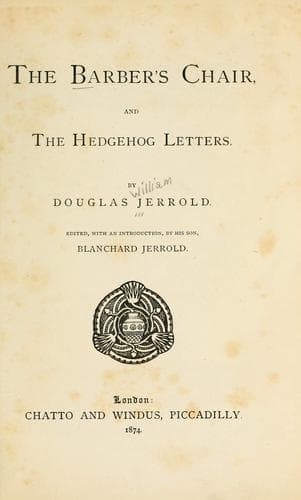
The barber's chair; and, The hedgehog lettersJerrold, Douglas William
General
The barber's chair; and, The hedgehog letters
Jerrold, Douglas William
English literature -- 19th century; English wit and humor
Pardon me, sir, but there never was such a mistake as to think to
do away with the wickedness of hanging by making it private. In the
first place, if to see a hanging is no warning to the beholder, do
you think that to hear or read of a hanging would do all the good of
an example? Does what men see, or what they hear, stir ’em the most?
But let us suppose that a man is to be hanged inside of Newgate. Why,
the penny-liners that get their sops in the pan out of the condemned
cell, why, they would write all sorts of pretty things, all kinds of
interesting stories about the last minutes of the criminal, and so
the curiosity of the town would be more agog than ever. The picture
newspapers that publish the murderers’ portraits--those family papers
for the instruction and amusement of the younger branches--would give
half-a-dozen pictures where they now give one. The secrecy of the thing
would give a flavour to the whole matter.
And now, suppose that a rich man was to be privately hanged: a banker,
we’ll say, or, saving your presence, even a member of Parliament. Well,
we know how unbelieving is man. There’s thousands of people who would
never sleep quietly in their beds, for the thought that the said banker
or member was never hanged at all, but was smuggled out alive in a
coffin, and shipped abroad. Every year or so, there’d be a letter in
the newspapers from somebody who had seen the banker somewhere in the
Backwoods, where he had married one of the Chactaws, and got a family
of ten children. No, Mr Milnes, private hanging won’t do; the people
aren’t to be cheated out of their pleasure after that fashion. Besides,
Mr Milnes, all hanging’s a bungle. The gallows is condemned, marked to
come down; timber by timber it’s loosening, and it’s no use trying to
keep it together with small corking-pins. No, Mr Milnes, it will better
become you, be more like your kind good-natured self, to give a pull
to the planks, to bring the whole machine to the ground, to make it a
thing of the past, like the bonfires that burnt witches,--and for the
hangman thrown out of work, why, small retiring allowances have been
given to worse public servants.--Hoping, sir, that you’ll excuse my
boldness, I remain, your obedient servant,
JUNIPER HEDGEHOG.
_P.S._--You know my number, sir, and I’m always in Palace Yard.
LETTER XIX.--_To Isaac Moss, Slop-seller, Portsmouth._
DEAR ISAAC,--Sir Robert Peel has stood your friend; and if you’ve
only the money, and the freedom, and the luck, you may be Lord
Mayor of London as soon as you like. You can’t, as a Jew, sit in
Parliament as yet; but time goes round, Isaac, and I shouldn’t wonder
if some day that was to come. Only think if a Jew--an hon. member
for Whitechapel--was some day to find himself alongside of a Colonel
Sibthorpe; for every Parliament has its Sibthorpe, just as every spring
has its green geese.
Public-domain text, read in full here on John Shaqi.
Reviews
Reviews
No reviews yet
Be the first to share your thoughts on this work.
Elsewhere in the archive
Join the Discussion
Join the discussion
Sign in to leave a comment or review.
Sign InorCreate an account