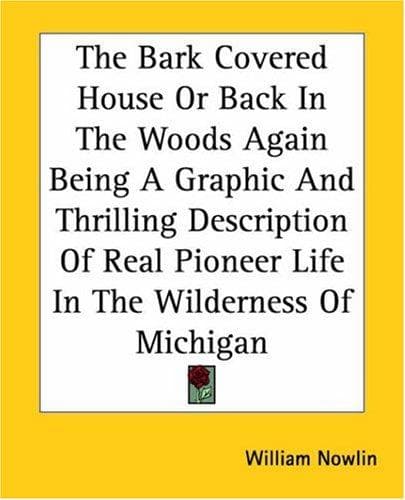
The Bark Covered House: Or, Back In the Woods Again; Being a Graphic and Thrilling Description of Real Pioneer Life in the Wilderness of MichiganNowlin, William
History
The Bark Covered House: Or, Back In the Woods Again; Being a Graphic and Thrilling Description of Real Pioneer Life in the Wilderness of Michigan
Nowlin, William
Dearborn (Mich.); Frontier and pioneer life -- Michigan -- Dearborn
But I must return to my drawing wood. The place where we heaped it was on
the north side of the railroad, about fifteen rods east of where the
postoffice is now kept. The woodyard, including the depot, I should
judge, was not more than one hundred feet square. Here we piled our wood,
sometimes ten feet high. We were to have seven shillings a cord for it
and if we chopped and hauled three cords a day we thought we did well. I
drew it as fast as I could, sometimes I got to Dearborn just as the old
Solar made his appearance in the east. The Lunar had already done her
work toward helping me, veiled her face and disappeared. When we had
drawn a lot of wood in father had it measured up and got his voucher for
the amount. One time when he went to Detroit to get his money I went with
him. We went on the cars. The depot and railroad office, where father did
his business, stood where the City Hall now stands. I thought the
railroad was a splendid thing. We went in so much nicer, easier and
quicker than we could have gone on foot, or with our ox-team.
Now we were going to get some money of the railroad officers, I thought
we would have money to pay the interest on our mortgage and help us
along. Father got his pay in Michigan State scrip, a substitute for
money. It was good for its face to pay State taxes; but to turn it into
money father had to sell it for six shillings on a dollar. Here it will
be seen, that what we really received for our wood, was a little over
sixty-five cents per cord, and that when we drew in three cords a day
(which was as much as father could chop, and all that I and the team
could draw) we made a little over a dollar and ninety-five cents per day.
What would some of the workingmen of the present day who get together and
form "Union Leagues," "Trade Unions," strike for higher wages and
conspire against their employers and their capital, doubtless thinking
such a course justifiable, think of such wages as that, and provisions
very dear, as they were at that time? I began to think myself rough and
ready and was able to grapple with almost anything and do a good days'
work. Father, I and the team all worked hard and with the wood thrown in
we all together did not make two dollars a day.
As father had a small job in the building of the railroad and some of the
time I was with him, I will describe as well as I can, how the railroad
was built. They first graded the road-bed and made it level, then took
timbers as long as the trees would make them, hewed them on each side and
flattened them down to about a foot in thickness, then laid them on
blocks which were placed in the bed of the road. They were laid
lengthwise of the road, far enough apart so that they would be directly
under the wheels of the cars, and the ground graded up around them. In
this manner they continued until the road-bed was finished.
Public-domain text, read in full here on John Shaqi.
Reviews
Reviews
No reviews yet
Be the first to share your thoughts on this work.
Elsewhere in the archive
Join the Discussion
Join the discussion
Sign in to leave a comment or review.
Sign InorCreate an account