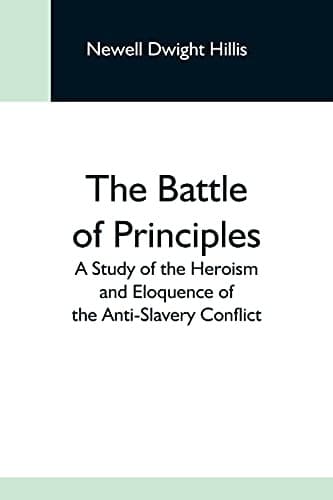
The Battle of Principles: A Study of the Heroism and Eloquence of the Anti-Slavery ConflictHillis, Newell Dwight
History
The Battle of Principles: A Study of the Heroism and Eloquence of the Anti-Slavery Conflict
Hillis, Newell Dwight
Antislavery movements -- United States; United States -- Politics and government -- 1861-1865
But the industrial conditions of life in the South were very different.
Be it remembered that the North was a self-supporting region, both as
to foods and manufactured articles, while the South, under slavery,
produced raw material, and used that raw stuff to build up factories in
England. When the war came the South found herself without the means of
supplying her own wants. Within six months the South discovered that
every axe and saw and steam-engine and iron rail and bolt and nail had
come from the North. Davis sent out men to scurry the country for old
stoves and every iron scrap was picked up to be melted into weapons. At
the close of the war tenpenny nails were used as five-cent pieces and
currency in North Carolina. To crown all other disasters came the
debasement of the currency. Macaulay says that the world has suffered
less from bad kings than from bad shillings and sixpences. The
Confederacy issued one billion dollars of paper money, States issued
another flood of promises to pay, cities put out municipal currency,
fire and life insurances their shin-plasters, and they kept pouring out
paper money until finally all the printing presses broke down. A month
before the collapse, a Confederate soldier, returning to his little
cabin, paid $10,000 for a fifteen-year-old mule, knee sprung in front
and spavined behind, and $7,500 for the shoes for shoeing the mule.
Lee's army would have collapsed but for the marvellous heroism,
resourcefulness and courage of the Southern women. They took charge of
the fields, planted the crops, gathered the harvests, and staggered on
to the end. Not one Northern home in five was death-stricken through the
war, but practically every Southern home had lost one or two members of
the family, through father, son or brother.
Nor must we forget what Lee owed to the fidelity of the negroes. Instead
of insurrection, arson, pillage and murder in Southern towns and old
homesteads, the Southern slave remained true to his mistress, and was
the very soul of fidelity. Yet when the war was over, the town had
become a wilderness, the plantation a desolation, and where there had
been prosperity and even luxury, famine and want and disease had set up
their abiding places. Verily secession sowed the wind and reaped the
whirlwind of destruction.
Public-domain text, read in full here on John Shaqi.
Reviews
Reviews
No reviews yet
Be the first to share your thoughts on this work.
Elsewhere in the archive
Join the Discussion
Join the discussion
Sign in to leave a comment or review.
Sign InorCreate an account