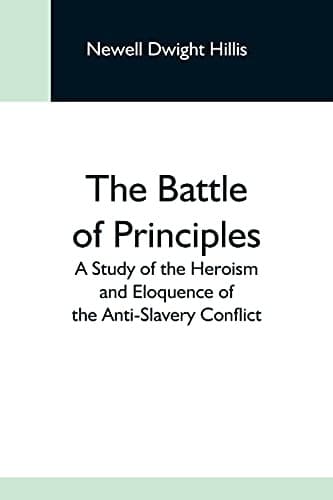
The Battle of Principles: A Study of the Heroism and Eloquence of the Anti-Slavery ConflictHillis, Newell Dwight
History
The Battle of Principles: A Study of the Heroism and Eloquence of the Anti-Slavery Conflict
Hillis, Newell Dwight
Antislavery movements -- United States; United States -- Politics and government -- 1861-1865
Anybody can be a giant in heroism and reform among Hottentots and South
Sea savages. But the era of the Civil War was an era of heroes. Great
men walked in regiments up and down the land. It was the age of Daniel
Webster, whose genius is so wonderful that he achieved the four supreme
things of four realms,--the greatest legal argument we have, the
Dartmouth College case; the greatest plea before a judge and jury, the
Knapp murder case; our finest outburst of inspirational eloquence, the
oration at Bunker Hill; the greatest argument in defense of the
Constitution, his reply to Hayne. It was the age of John C. Calhoun, a
statesman whose political theories led half a continent to deeds of
daring war. It was the era of Seward, the all-round scholar, of Chase
the greatest secretary of treasury since Alexander Hamilton, a man who
struck the rock with the rod of his genius, and made the waters of
finance flow forth from the desert. It was the age of our greatest
orators, for then Wendell Phillips and Beecher were at their best. It
was the era of Emerson, the philosopher; of Theodore Parker, the
reformer; of Garrison, the abolitionist; of Lovejoy, the martyr; of
Lowell and Whittier, the poets of freedom; of Greeley, the editor; it
was also the age of the greatest soldiers, Grant and Sherman, and
Sheridan and Lee. The great man is a form of fruit ripened in an
atmosphere made warm and genial, and the climate that nurtured Lincoln
unfolded the talents that represented also other forms of mental fruit.
Among these men Lincoln lived and wrote and spoke, and suffered and
died;--but he stands forth a master among men, an indisputable genius,
one of the five supreme statesmen of all history.
Now if we are to understand the unique place of Abraham Lincoln in our
history we must recall again for a moment the men who set the battle
lines in array. Unfortunately, most of our histories tell our children
and youth that the Civil War raged about the slave. As a matter of fact,
slavery was the occasion of the war, but not the cause. Slavery was the
sulphur match that exploded the powder magazine, though the powder
magazine could have been set off by a spark from the flint and steel, or
a hundred other methods.
The Civil War was really fought over the question whether a
constitutionally formed nation dedicated to the proposition that all men
are created equal could permanently endure. The whole period from 1789
to 1865 was a critical period, during which the Constitution was being
tested and tried out.
Public-domain text, read in full here on John Shaqi.
Reviews
Reviews
No reviews yet
Be the first to share your thoughts on this work.
Elsewhere in the archive
Join the Discussion
Join the discussion
Sign in to leave a comment or review.
Sign InorCreate an account