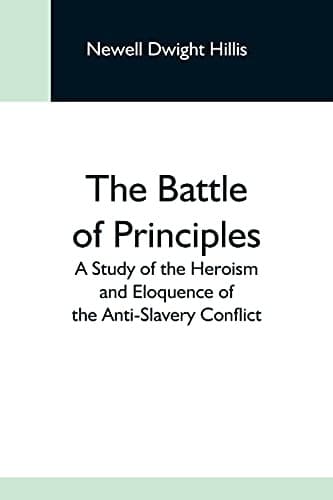
The Battle of Principles: A Study of the Heroism and Eloquence of the Anti-Slavery ConflictHillis, Newell Dwight
History
The Battle of Principles: A Study of the Heroism and Eloquence of the Anti-Slavery Conflict
Hillis, Newell Dwight
Antislavery movements -- United States; United States -- Politics and government -- 1861-1865
More striking still, Lincoln's trust in God and His overruling
providence. Mr. Herndon in his biography and Dr. Abbott in an editorial
and an oration at Cooper Institute emphasize the agnosticism of Lincoln.
The one says that in his youth he wrote an article against Christianity,
and the other that he was not a technical Christian. Dr. Abbott thinks
all this so important that he places the agnosticism of Lincoln at the
forefront. But too much has been made of the schoolboy article of
Lincoln on doubt and infidelity. In his youth Gladstone was a Tory, but
he outgrew it. In the outset Paul was against Christianity. Tennyson and
Wordsworth in their teens wrote puerile verse, just as Lincoln in his
teens wrote a foolish paper. But it is cruelly unfair not to allow
Abraham Lincoln the full benefit of what he came to be, and not to take
the man at his best. It is unfair to say that a man is what he is at his
worst and lowest point; a man is what he is at his best and highest
point. Stephen A. Douglas said Lincoln was the most honest man he ever
knew. Well, if Lincoln was an honest man in his character, he must have
been honest in talking about his religion and his faith in God. Was
Abraham Lincoln an agnostic in that hour when he spoke his farewell
words to his neighbours in Springfield, about starting on the memorable
journey to his inauguration? He said: "I feel that I cannot succeed
without the same divine aid that sustained Washington, and on the same
Almighty Being I place my reliance for support; and I hope you, my
friends, will all pray that I may receive that divine assistance without
which I cannot succeed, but with which success is certain." Was Abraham
Lincoln without faith, and did he play to the gallery, when he set apart
a day of fasting and prayer after the defeat at Bull Run? Having said
that Abraham Lincoln was an honest man, why not remember it, when these
critics read his First Inaugural, in which he declares that
"intelligence, patriotism, Christianity, and a firm reliance on Him who
has never yet forsaken this favoured land, are still competent to adjust
in the best way all our present difficulty." When Abraham Lincoln wrote
the mother, Mrs. Bixby, "I pray that the heavenly Father may assuage the
anguish of your bereavement," he meant that he believed in God, in a God
who answered prayer, in a God who cared for the mother living, and the
five brave boys dead. "The Almighty has His own purposes," said Lincoln,
in the Second Inaugural, an address that is steeped in religion, that
exhales trust in God. Take God out of that Second Inaugural, and it
would be like taking health out of the body, wisdom out of the book,
sweetness out of the song, culture out of the intellect, life out of the
body. You cannot in one breath say that Lincoln was an agnostic, and
then in the next one say that Lincoln was an honest man. I care not one
whit what Mr. Herndon says. I care everything about what Abraham Lincoln
Public-domain text, read in full here on John Shaqi.
Reviews
Reviews
No reviews yet
Be the first to share your thoughts on this work.
Elsewhere in the archive
Join the Discussion
Join the discussion
Sign in to leave a comment or review.
Sign InorCreate an account