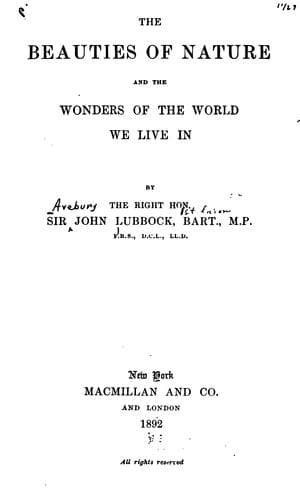
The Beauties of Nature, and the Wonders of the World We Live InLubbock, John, Sir
Philosophy
The Beauties of Nature, and the Wonders of the World We Live In
Lubbock, John, Sir
Astronomy; Natural history; Physical geography
This has affected many of the other tributaries of the Ganges, so that
the survey made by Rennell in 1780-90 is no longer any evidence as to
the present course of the rivers. They may now be anywhere else; in some
cases all we can say is that they are certainly not now where they were
then.
The association of the three great European rivers, the Rhine, the
Rhone, and the Danube, with the past history of our race, invests them
with a singular fascination, and their past history is one of much
interest. They all three rise in the group of mountains between the
Galenstock and the Bernardino, within a space of a few miles; on the
east the waters run into the Black Sea, on the north into the German
Ocean, and on the west into the Mediterranean. But it has not always
been so. Their head-waters have been at one time interwoven together.
At present the waters of the Valais escape from the Lake of Geneva at
the western end, and through the remarkable defile of Fort de l'Ecluse
and Malpertius, which has a depth of 600 feet, and is at one place not
more than 14 feet across. Moreover, at various points round the Lake of
Geneva, remains of lake terraces show that the water once stood at a
level much higher than the present. One of these is rather more than 250
feet[54] above the lake.
A glance at the map will show that between Lausanne and Yverdun there is
a low tract of land, and the Venoge, which falls into the Lake of Geneva
between Lausanne and Morges, runs within about half a mile of the Nozon,
which falls into the Lake of Neuchatel at Yverdun, the two being
connected by the Canal d'Entreroches, and the height of the watershed
being only 76 metres (250 feet), corresponding with the above mentioned
lake terrace. It is evident, therefore, that when the Lake of Geneva
stood at the level of the 250 feet terrace the waters ran out, not as
now at Geneva and by Lyons to the Mediterranean, but near Lausanne by
Cissonay and Entreroches to Yverdun, and through the Lake of Neuchatel
into the Aar and the Rhine.
But this is not the whole of the curious history. At present the Aar
makes a sharp turn to the west at Waldshut, where it falls into the
Rhine, but there is reason to believe that at a former period, before
the Rhine had excavated its present bed, the Aar continued its course
eastward to the Lake of Constance, by the valley of the Klettgau, as is
indicated by the presence of gravel beds containing pebbles which have
been brought, not by the Rhine from the Grisons, but by the Aar from the
Bernese Oberland, showing that the river which occupied the valley was
not the Rhine but the Aar. It would seem also that at an early period
the Lake of Constance stood at a considerably higher level, and that the
outlet was, perhaps, from Frederichshaven to Ulm, along what are now the
valleys of the Schussen and the Ried, into the Danube.
Public-domain text, read in full here on John Shaqi.
Reviews
Reviews
No reviews yet
Be the first to share your thoughts on this work.
Elsewhere in the archive
Join the Discussion
Join the discussion
Sign in to leave a comment or review.
Sign InorCreate an account