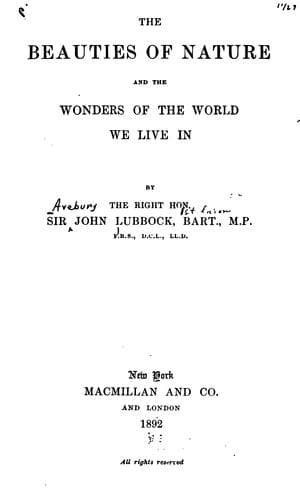
The Beauties of Nature, and the Wonders of the World We Live InLubbock, John, Sir
Philosophy
The Beauties of Nature, and the Wonders of the World We Live In
Lubbock, John, Sir
Astronomy; Natural history; Physical geography
5. Lakes in craters of extinct volcanoes, for instance, Lake Avernus.
6. Those caused by subsidence due to the removal of underlying soluble
rocks, such as some of the Cheshire Meres.
7. Loop lakes in deserted river courses, of which there are many along
the course of the Rhine.
8. Those due to rockfalls, landslips, or lava currents, damming up the
course of a river.
9. Those caused by the advance of a glacier across a lateral valley,
such as the Mergelen See, or the ancient lake whose margins form the
celebrated "Parallel Roads of Glen Roy."
As regards the first class we find here and there on the earth's surface
districts sprinkled with innumerable shallow lakes of all sizes, down to
mere pools. Such, for instance, occur in the district of Le Doubs
between the Rhone and the Saone, that of La Sologne near Orleans, in
parts of North America, and in Finland. Such lakes are, as a rule,
quite shallow. Some geologists, Geikie, for instance, ascribe them to
the fact of these regions having been covered by sheets of ice which
strewed the land with irregular masses of clay, gravel, and sand, lying
on a stratum impervious to water, either of hard rock such as granite or
gneiss, or of clay, so that the rain cannot percolate through it, and
without sufficient inclination to throw it off.
2. To Ramsay's second class of Lakes belong those formed by moraines.
The materials forming moraines being, however, comparatively loose, are
easily cut through by streams. There are in Switzerland many cases of
valleys crossed by old moraines, but they have generally been long ago
worn through by the rivers.
3. Ramsay and Tyndall attribute most of the great Swiss and Italian
lakes to the action of glaciers, and regard them as rock basins. It is
of course obvious that rivers cannot make basin-shaped hollows
surrounded by rock on all sides. The Lake of Geneva, 1230 feet above the
sea, is over 1000 feet deep; the Lake of Brienz is 1850 feet above the
sea, and 2000 feet deep, so that its bottom is really below the sea
level. The Italian Lakes are even more remarkable. The Lake of Como, 700
feet above the sea, is 1929 feet deep. Lago Maggiore, 685 feet above the
sea, is no less than 2625 feet deep.
If the mind is at first staggered at the magnitude of the scale, we must
remember that the ice which is supposed to have scooped out the valley
in which the Lake of Geneva now reposes, was once at least 4000 feet
thick; while the moraines were also of gigantic magnitude, that of
Ivrea, for instance, being no less than 1500 feet above the river, and
several miles long.
Public-domain text, read in full here on John Shaqi.
Reviews
Reviews
No reviews yet
Be the first to share your thoughts on this work.
Elsewhere in the archive
Join the Discussion
Join the discussion
Sign in to leave a comment or review.
Sign InorCreate an account