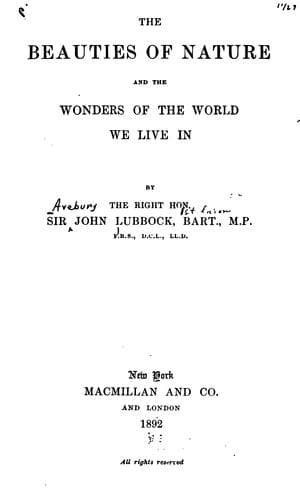
The Beauties of Nature, and the Wonders of the World We Live InLubbock, John, Sir
Philosophy
The Beauties of Nature, and the Wonders of the World We Live In
Lubbock, John, Sir
Astronomy; Natural history; Physical geography
During the earthquakes of 1819 while part of the Runn of Cutch, 2000
square miles in area, sunk several feet, a ridge of land, called by the
natives the Ulla-Bund or "the wall of God," thirty miles long, and in
parts sixteen miles wide, was raised across an ancient arm of the Indus,
and turned it temporarily into a lake.
In considering the great Italian lakes, which descend far below the sea
level, we must remember that the Valley of the Po is a continuation of
the Adriatic, now filled up and converted into land, by the materials
brought down from the Alps. Hence we are tempted to ask whether the
lakes may not be remains of the ancient sea which once occupied the
whole plain. Moreover just as the Seals of Lake Baikal in Siberia carry
us back to the time when that great sheet of fresh water was in
connection with the Arctic Ocean, so there is in the character of the
Fauna of the Italian lakes, and especially the presence of a Crab in the
Lake of Garda, some confirmation of such an idea. Further evidence,
however, is necessary before these interesting questions can be
definitely answered.
Lastly, some lakes and inland seas seem to be due to even greater
cosmical causes. Thus a line inclined ten degrees to the pole beginning
at Gibraltar would pass through a great chain of inland waters--the
Mediterranean, Black Sea, Caspian, Aral, Baikal, and back again through
the great American lakes.
But though many causes have contributed to the original formation and
direction of Valleys, their present condition is mainly due to the
action of water. When we contemplate such a valley, for example, as that
which is called _par excellence_ the "Valais," we can at first hardly
bring ourselves to realise this; but we can trace up valleys, from the
little water-course made by last night's rains up to the greatest
valleys of all.
These considerations, however, do not of course apply to such
depressions as those of the great oceans. These were probably formed
when the surface of the globe began to solidify, and, though with many
modifications, have maintained their main features ever since.
ON THE CONFIGURATION OF VALLEYS
The conditions thus briefly described repeat themselves in river after
river, valley after valley, and it adds, I think, very much to the
interest with which we regard them if, by studying the general causes to
which they are due, we can explain their origin, and thus to some extent
understand the story they have to tell us, and the history they record.
Public-domain text, read in full here on John Shaqi.
Reviews
Reviews
No reviews yet
Be the first to share your thoughts on this work.
Elsewhere in the archive
Join the Discussion
Join the discussion
Sign in to leave a comment or review.
Sign InorCreate an account